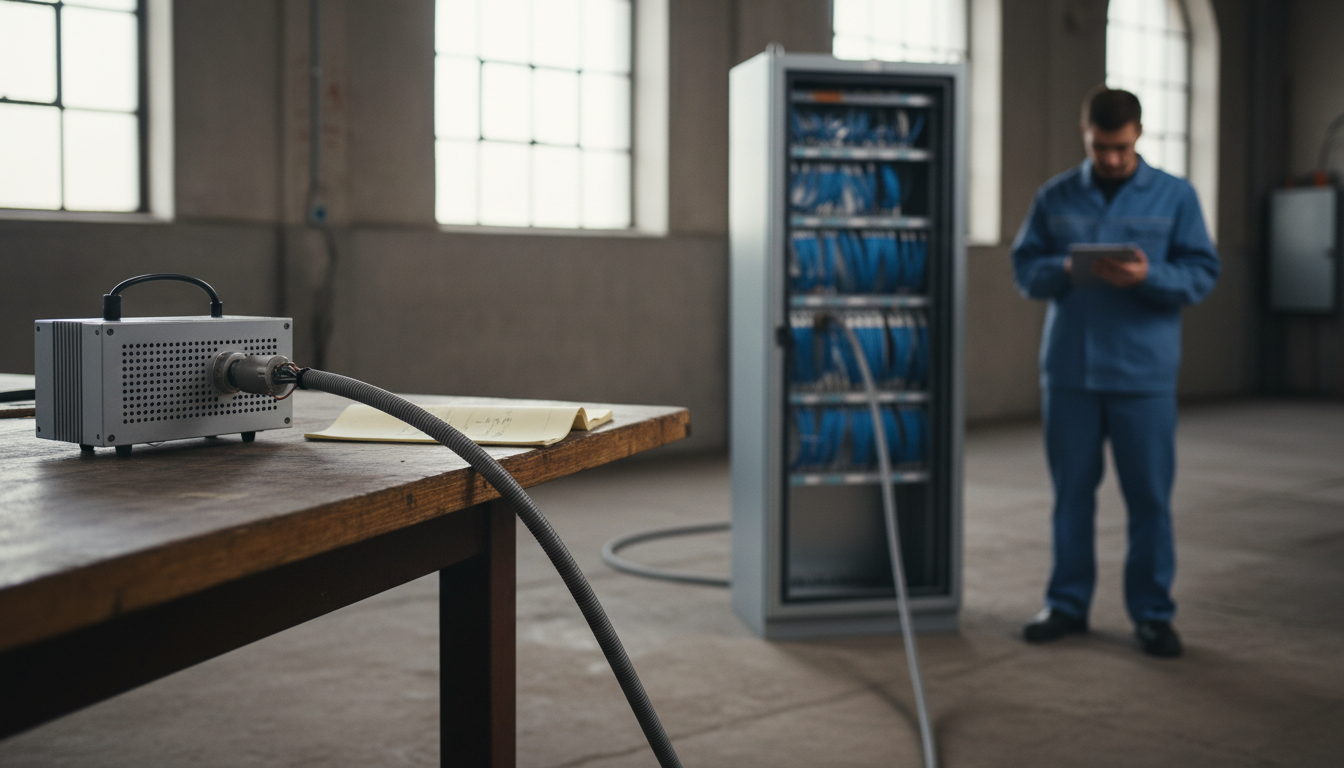
An AI workflow is only reliable once you can also verify the underlying infrastructure: the routing (via RPKI route validation), the registry's trust anchor and logging, the access controls and the control surface of connected robots. Without demonstrable control over those layers, correct model behaviour says nothing about the reliability of the whole chain.
This infrastructure verification for AI workflows is made concrete by two recent developments. On 15 May 2026, APNIC announced a collaboration with NNIX to further roll out RPKI and IPv6 in China, including a local RPKI repository mirror to make validation faster and more accessible. At the same time, SecurityWeek reported on 16 September 2026 that a critical vulnerability exposes some industrial robot fleets to hacking via network-reachable control interfaces. Our editorial reading: these are two faces of the same verification problem in AI-driven and robot-driven workflows.
What do the RPKI updates from APNIC and RIPE NCC mean for the reliability of my data traffic?
According to APNIC, RPKI (Resource Public Key Infrastructure) is a cryptographic framework for securing internet routing. In short, a ROA (Route Origin Authorisation) records which Autonomous System Number may announce an IP prefix, and with ROV (Route Origin Validation) operators can reject invalid routes. In its overview of resource certification, APNIC describes both hosted and self-hosted models, validators and ASPAs as practical building blocks.
The governance behind such a system is at least as important as the technology. The Certification Practice Statement that RIPE NCC published on 13 January 2026 documents the operational and audit controls around a real trust anchor: hosted and delegated CAs, publication of the repository, audit logging, key management and periodic reviews. In our estimation, that is precisely why RPKI is relevant to AI users: if you cannot establish that the route path of your data traffic is valid and has not been hijacked, you have weaker assurance that data reached its intended destination unchanged.
Why should I treat industrial and surgical robots as attackable cyber-physical systems?
The robot issue is neither new nor marginal. On 19 August 2026, the University of Illinois Urbana-Champaign reported that a 2016 study into the security of a surgical robot won the DSN Test of Time Award. That research demonstrated at the time that attackers could abuse a robot's control systems. The university points out that connected robots are now also gaining increasing AI capabilities, which increases the need for stronger safety and security assurances.
SecurityWeek's recent report ties in with this: with industrial robots and cobots, command injection via exposed control interfaces can lead to remote code execution and compromise of the controller and even the entire fleet. The practical consequence is that you must not view a robot as an isolated machine, but as a cyber-physical system with a control surface that is attackable. Anyone deploying AI-driven robot workflows therefore verifies not only the model's decision, but also who may issue the command and whether that command is authentic.
Which infrastructure layers should I concretely verify before I trust an AI workflow?
We translate the two developments into a verifiable list. This is editorial analysis, not a statement by the named sources:
- Routing: does your network validate routes with ROV and do you publish ROAs for your own prefixes, as APNIC describes?
- Trust anchor and logging: do you know which CA structure, repository and audit logging sit behind your route validation, in line with the RIPE NCC practice statement?
- Access control: who may send commands to the control interfaces of robots or other connected devices, and is that access shielded from the open network?
- Control surface: is command injection ruled out and do you log which commands were executed?
- Data provenance: can you demonstrate along which path data entered and left your AI chain?
Anyone who wants to decide per workflow what runs locally and what runs in the cloud can best substantiate that choice by auditing per workflow what runs locally and what runs in the cloud. For the attack perspective it helps to set up red teaming for AI agents in three layers, so that you make the weakest layer visible before an attacker does.
How does verifying model output relate to verifying the underlying infrastructure?
The common thread is that trust is only as strong as the weakest infrastructure layer. A well-behaved model communicating over a hijacked route path, or a robot neatly executing an injected command, does not deliver a reliable outcome. Verification of model output and verification of routing, access, logging and control are therefore complementary, not interchangeable. More background to this reasoning can be found in our topic hub on AI security and controllable AI chains.
For the output layer itself it is useful to make a wrong AI answer traceable per workflow, so that you can reconstruct where something went wrong. A verification layer such as Vera can help here by routing a task through several independent models and making the verification steps, corrections, disagreements and sources visible for inspection. That supports control over the output, but it is no guarantee of correctness. Moreover, it does not cover the network and control layers: those remain a separate responsibility. The professional final judgement always remains with you.
Analysis: if you do one thing today, map which of the five layers above you can actually demonstrate. The source data show that route validation and robot control are both being actively addressed; the question is whether your own chain offers the same control.
Sources and references
- RPKI (Resource Certification)
- APNIC and NNIX collaborate to strengthen RPKI and IPv6 deployment in China
- RIPE NCC Certification Practice Statement (CPS) for the Resource Public Key Infrastructure (RPKI)
- Critical Vulnerability Exposes Industrial Robot Fleets to Hacking
- Study of a surgical robot's security vulnerability wins DSN Test of Time Award
Sources: The article relies on APNIC and RIPE NCC for RPKI route validation and governance, and on SecurityWeek and the University of Illinois Urbana-Champaign for the vulnerability of industrial and surgical robots.