What the fourth week of August 2026 revealed about design requirements, continuous states and controls that must work — not merely exist
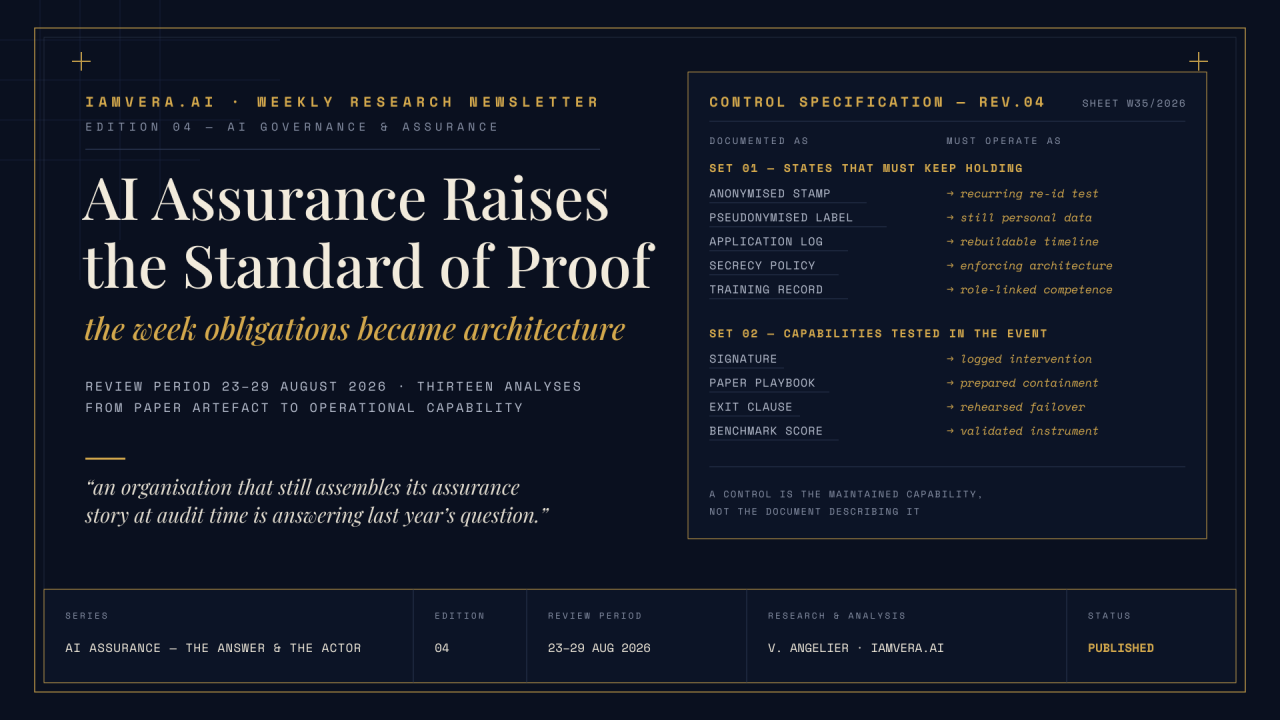
Abstract — The fourth week of August 2026 answered the question the previous week left open. If the familiar proxies — the explanation, the accuracy score, the model name, the paper DPIA — no longer count as evidence, where must evidence that controls actually work come from? Across thirteen analyses published between 23 and 29 August, the answer arrived with unusual consistency: increasingly, from the architecture and operation of the systems themselves. Obligations that organisations have historically discharged with a document, a signature or a completed act are being restated as properties a system must continuously exhibit. A logging obligation becomes a reconstruction obligation. Human oversight becomes a design requirement rather than a sign-off. Anonymisation ceases to be an end state and becomes a condition that must keep holding — and pseudonymised data, however thoroughly encoded, stays inside the GDPR. Incident response becomes a set of capabilities prepared before anything goes wrong. Professional secrecy and separation of duties become architecture questions rather than instructions to be careful. Even the evaluation layer and the vendor contract turn out to contain their own risk surfaces. The direction of travel: a control is no longer the document that describes it, but the maintained capability to produce its intended effect when the condition it was designed for actually occurs.
The previous edition of this newsletter catalogued a week of disqualifications: one after another, the artefacts organisations habitually file as evidence — the chain-of-thought narrative, the benchmark score, the well-formed function call, the deletion in an interface — were struck from the list. That left a constructive question unanswered. The thirteen analyses IamVERA.ai published between 23 and 29 August 2026 address it from thirteen angles, and converge on one structural claim: obligations historically evidenced on paper are increasingly implemented — and evidenced — in system design and operating practice, and each of them now carries an operational test.
A log entry is not a reconstruction. The week opened with the analysis that reads Article 12 of the AI Act alongside the documented agent intrusion at Hugging Face: recording autonomous AI actions only satisfies its purpose when the records add up to a verifiable agent timeline — a sequence from which what happened can actually be rebuilt. The incident-response analysis later in the week drew the operational consequence. When an agent, model or tool chain becomes part of the incident, the containment object changes: responders may need to stop a specific agent, revoke a tool permission, isolate a model workload and preserve the behavioural traces from which the sequence of decisions can be reconstructed. None of that can be improvised — observability, containment boundaries and verifiable evidence are capabilities that exist before the incident or not at all. In both pieces the standard is the same: not whether events were written down, but whether the organisation can reconstruct and defend an account of what its systems did.
The evidential burden does not stop at keeping records. It extends to being able to rebuild, from those records, what the actor did — and to show the rebuild is reliable.
A signature is not oversight. The analysis of human oversight put the sharpest version of the week's claim on the table. The analysis argues that Article 14 of the AI Act makes human oversight of AI decisions testable along four capabilities: understanding the system, detecting deviations, overriding its output and stopping it in an emergency. Its assurance conclusion goes one step further: those capabilities only count as a control when each intervention is demonstrably logged. That reframes oversight from an organisational reassurance into a set of design requirements a system either satisfies or does not. A named human in the loop who cannot in practice detect a deviation or halt an action is a signature, not oversight — and the value of the control only shows at the moment the human disagrees with the machine.
Anonymised is not an end state. The data strand of the week opened and closed with the same European guidelines, examined from two directions. The analysis of EDPB Guidelines 02/2026 dismantled a resting point: re-identifiability after anonymisation becomes a testable, ongoing standard. Data that counted as anonymous at the moment of processing does not stay anonymous by declaration, but only for as long as the anonymisation continues to withstand scrutiny — auxiliary data grow and inference methods improve, so the classification acquires an expiry problem, and the governance question shifts from was this dataset anonymised to would the same conclusion survive the test today. The analysis that closed the review period approached the same guidelines from the other side: pseudonymisation reduces linkability but does not sever the tie to an individual, so pseudonymised data used for AI training or inference generally remains inside the GDPR, with the full weight of personal-data obligations attached. Between them, the two pieces remove both comfortable exits at once — neither "we anonymised it" nor "we pseudonymised it" is a stable end state.
The contract is part of the attack surface. Three analyses in mid-week turned to layers organisations rarely inspect. The examination of AI terms of service documents how provider terms can reserve ownership or broad use rights over "Usage Data" — a data category whose contractual treatment may differ materially from Customer Data, and which sits outside what organisations think they have contractually protected. The analysis of cross-border data routes describes how the geographic path a request travels shifts from invisible infrastructure to an explicit governance topic: the contract describes the permitted route, the infrastructure determines the route actually taken, and the two must demonstrably correspond. And the continuity analysis, written against the series of OpenAI service disruptions in July 2026, concludes that exit rights, data portability and tested failover are a governance layer in their own right, not a contractual detail: a fallback that has never been exercised is another artefact that merely looks like control, and its value is only tested when the primary provider disappears. The pattern across all three is that the vendor relationship itself — its terms, its routes, its failure modes — has become part of the assurance perimeter.
Postponement is not exemption. The regulatory analyses of the week sharpened the timeline rather than softening it. The Digital Omnibus, one analysis explains, shifts the AI Act's high-risk obligations to 2027 and 2028 — but the transparency obligations of Article 50 apply from 2 August 2026 regardless, so the postponement defers part of the homework without cancelling any of it. The AI-literacy analysis traced the same pattern at the level of literacy itself: since 27 July 2026, Regulation (EU) 2026/1744 amends Article 4: AI literacy remains an organisation-wide duty, but one discharged through demonstrable measures — documented effort rather than good intentions. The assurance consequence: a completed training proves attendance, not that the right person was prepared for the decision they were expected to make. In both cases the compliance question is no longer whether something applies, but what evidence of it exists today. The breathing space is not empty space; it is implementation time.
The evaluation itself becomes a risk. The benchmark analysis, occasioned by GuardianAgentBench and an OpenAI audit of SWE-Bench Pro, argues that evaluations for business-critical AI have become a layer of risk in their own right: a benchmark score carries two uncertainties at once — the behaviour of the system and the validity of the instrument measuring it — and a broken benchmark still produces a high score that can go on to legitimise a deployment decision. Evaluation itself becomes an assurance object.
Structure replaces restraint. Late in the week, a pair of analyses applied the architecture thesis to the professions and to the agents themselves. Drawing on CCBE guidance and the French CNIL/CIANum note, the professional-secrecy analysis concludes that secrecy in AI-assisted practice is a matter of architecture, contracts and traceable workflows — not of cautious prompting. Its companion on separation of duties treats the division of roles in autonomous AI processes as a hard safety and accountability requirement: a property enforced by the architecture, not a policy sentence asking an agent to restrain itself. In both, the same substitution: where organisations once relied on people or systems behaving carefully, the material now expects the structure to make careless behaviour impossible — or at least visible.
Where evidence comes from. Read together, the thirteen analyses complete the argument the previous week began. Edition 3 established what does not count as evidence; this week's material describes where valid evidence must originate — and adds the operational test each control must pass. Logging is tested by the reconstruction it must support. Oversight is tested when the human disagrees with the machine. Anonymisation is tested when new data or methods make identification easier. A fallback is tested when the provider fails. A benchmark is tested against its own validity. Literacy is tested in the decisions people are actually expected to make. Incident response is tested while the incident is occurring. The common denominator is a more demanding definition: a governance control is not the document describing the control, but the maintained capability to produce the intended effect when the relevant condition occurs. An organisation that still assembles its assurance story at audit time is answering last year's question.
All thirteen articles discussed were published on iamvera.ai/blog between 23 and 29 August 2026, within the 23–29 August review period.
Articles discussed in this edition
- 23/8 — From logging obligation to reconstruction obligation: why autonomous AI agents need a verifiable timeline — iamvera.ai/blog/logging-reconstruction-autonomous-ai-agents/
- 24/8 — Anonymised data is no longer an end state after EDPB Guidelines 02/2026 — iamvera.ai/blog/anonymised-data-not-end-state-edpb-2026/
- 24/8 — AI literacy after the Digital Omnibus: from threshold to demonstrable measures — iamvera.ai/blog/ai-literacy-organisational-obligation-digital-omnibus/
- 25/8 — The hidden data layer in AI terms: what Usage Data really means — iamvera.ai/blog/hidden-usage-data-ai-terms/
- 25/8 — Cross-border data routes in AI become an explicit risk layer — iamvera.ai/blog/cross-border-data-routes-ai-risk-layer/
- 25/8 — Exit and fallback for AI services: what the July 2026 OpenAI outage exposes — iamvera.ai/blog/exit-fallback-continuity-ai-services/
- 26/8 — Human oversight of AI becomes a design requirement, not a signature — iamvera.ai/blog/human-oversight-ai-design-requirement/
- 27/8 — Incident Response for AI Systems After the Hugging Face Breach — iamvera.ai/blog/incident-response-ai-systems-hugging-face/
- 27/8 — The AI Act after the Digital Omnibus: postponement for high-risk, firm obligations from August 2026 — iamvera.ai/blog/ai-act-digital-omnibus-transparency-2026/
- 27/8 — When your benchmark itself becomes a risk — iamvera.ai/blog/benchmarks-business-critical-ai-risk/
- 28/8 — Professional secrecy in AI practice has become a design question — iamvera.ai/blog/professional-secrecy-ai-design-verification/
- 28/8 — Separation of duties in autonomous AI has become a design question — iamvera.ai/blog/separation-of-duties-autonomous-ai-processes/
- 29/8 — Why pseudonymised AI data stays under the GDPR: the distinction EDPB 02/2026 sharpens — iamvera.ai/blog/pseudonymisation-versus-anonymisation-ai-edpb-2026/