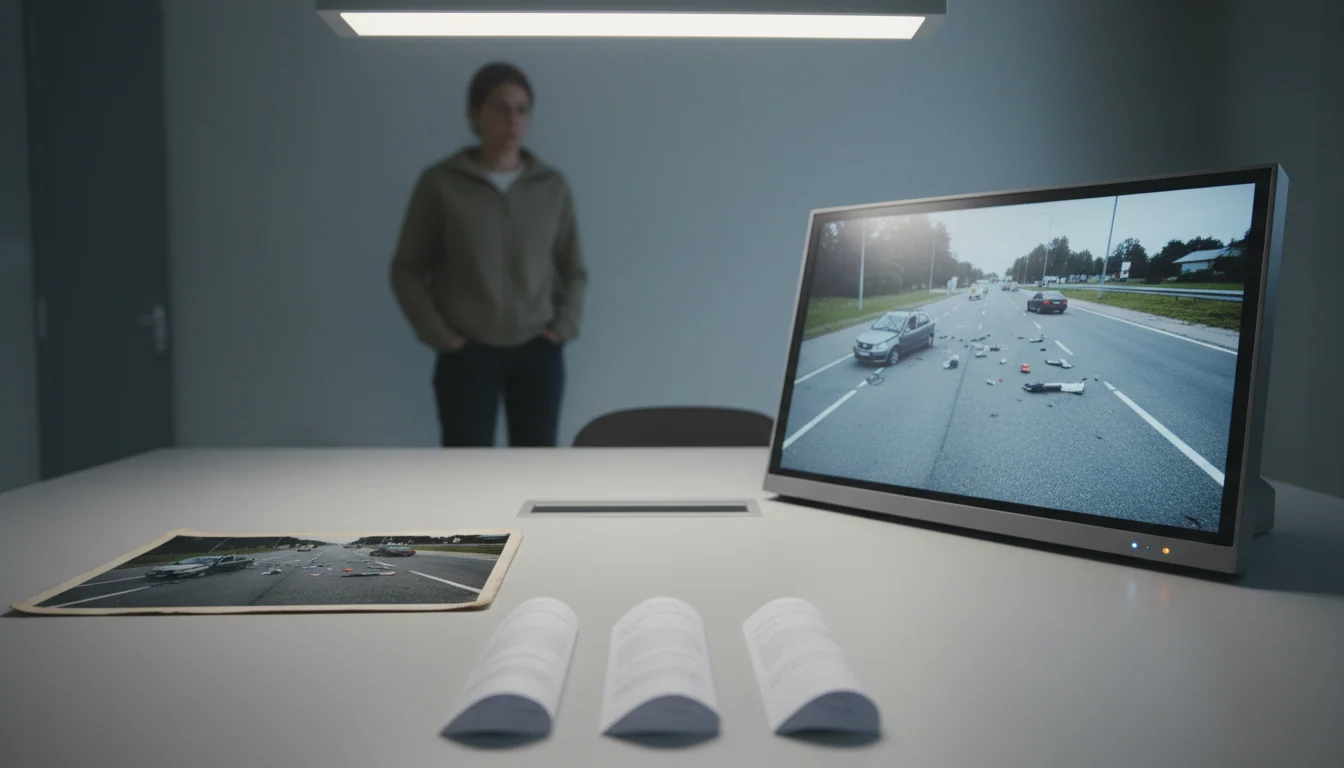
Two studies show that AI can distort people's memory: AI-edited images can strengthen false memories and misleading AI summaries lowered accurate recollection of a previously viewed event. Anyone working with evidence, testimony or case files should treat AI output as a possible intervention in memory, not a neutral representation.
Researchers from Georgetown University and the University of Washington made available an experiment with human participants in late September 2026 that reports a misleading AI summary distorts the memory of a previously viewed event. This memory distortion occurred in participants who read an inaccurate summary after watching an animated video of a traffic accident: they recalled a crucial detail correctly considerably less often than participants who received an accurate summary. That is consistent with an earlier study by the MIT Media Lab from April 2025, in which AI-edited images and AI-generated videos increased the likelihood of false memories.
Together, both studies point to something that is easily lost in the scattered reporting: AI can influence memory along two different routes. Not only through manipulated images, but also through text that looks reliable and authoritative. In our assessment, this second route is the most underestimated for decision-makers, because a summary is rarely seen as manipulation.
What exactly did the researchers establish about AI and memory?
The Georgetown and Washington researchers Mattea Sim, Yael Eiger and Tadayoshi Kohno reported in their open-access paper that participants recalled a critical detail correctly in 83.6 per cent of cases after an accurate summary, compared with 44.8 per cent after a misleading summary. The MIT Media Lab reported in a preregistered experiment with two hundred participants that AI-edited visuals increased false memories, with a reported 2.05-fold effect in the strongest condition compared with the control group.
- Visual route (MIT): AI-edited images and AI-generated videos raised the likelihood of false memories.
- Textual route (Georgetown/Washington): a misleading AI summary lowered accurate recollection of a previously viewed event.
- Experimental sequence: in the summaries study, the reported memory distortion occurred after participants had already viewed the original event; the MIT study separately examined how exposure to AI-altered visual material affected false recollection.
Why must you distinguish between authenticity, accuracy and memory effect?
Because three questions that often get lumped together are actually separate. The first: has an image, video or summary been created or edited by AI? The second: is its factual content correct? The third: can exposure to it have changed a person's memory? The findings show that exposure to inaccurate or edited information can influence memory; an AI label therefore does not automatically answer the question of what memory effect the material has had.
Our interpretation: a label such as "generated with AI" only answers the first question. It says nothing about accuracy and nothing about the effect on the memory of whoever read or saw it. Anyone who treats a label as proof of reliability confuses three different things. That difference is decisive once a memory later counts as testimony or a statement.
What does this mean for directors, lawyers and others who work with evidence?
Our analysis: because a misleading AI summary in this experiment measurably lowered accurate recollection of a previously viewed event, an organisation that first lets witnesses or those involved read an AI summary runs the risk that a later statement is influenced; therefore an investigator or lawyer should, where possible, first have witnesses record their own memory before they see any AI-generated material. Because AI-edited images strengthened false memories, this also affects loss adjusters, insurers and journalists who show reconstructed or illustrated situations; therefore the primary recording must remain strictly separate from any AI derivative, and it must be traceable in every decision which material was the source. Because the researchers reported susceptibility to misleading summaries regardless of whether participants believed the summary was AI-generated or human-written, a CISO or data protection officer cannot make do with a provenance label on the file; therefore it must be recorded at each process step which AI material was shown to whom and when, so that a later memory can be set against that exposure. And because an authoritative-looking summary steers memory, a director who relies on AI summaries for consequential decisions must require independent confirmation of load-bearing facts before that summary factors into the decision-making.
Anyone wanting to translate this reasoning into policy can summarise this analysis in a series of steps. See also our topic hub on AI governance and responsible use.
- Record original recordings and source files unchanged and store them separately from any AI derivative.
- Have witnesses or those involved record their memory before exposure to generated material, where feasible.
- Label AI transformations, but never treat a label as proof of accuracy.
- Document which AI material was shown to whom and when.
- Confirm consequential claims independently before they factor into a decision.
Which measures prevent AI output from irreversibly influencing a memory?
Above all, measures that protect the source material and control the order of exposure. In our assessment, the risk of memory distortion deserves primarily preventive attention: once someone has processed a misleading summary or an edited image, it can afterwards be difficult to establish which part of the later memory was shaped by the original event and which part by the exposure. Therefore the emphasis lies on prevention, not on correction after the fact.
This directly touches on known pitfalls of AI summaries, where AI summaries of legal files drop load-bearing arguments and tracing back to the source remains necessary. It also ties in with building a defensible verification chain around AI output. And it explains why an audit trail can suggest control without proving it: recording that someone saw a summary does not prove that the summary was correct. Independent reporting confirmed that the AI summaries in the study omitted a substantial part of the central details, according to the coverage of the research in an independent media report on the Georgetown-Washington research.
The core message for decision-makers is sober: AI-assisted presentation can influence the evidence it is supposed to represent. That makes the separation between source and derivative, and the question of who saw what when, a governance question and not merely a technical one.
Sources and references
- Synthetic Human Memories: AI-Edited Images and Videos Can Implant False Memories and Distort Recollection
- AI-Enabled Human Memory Manipulation: Misleading AI-Generated Summaries Distort Human Memory
- New Research Finds That Misleading AI-Generated Summaries Can Distort Human Memory
- AI-generated summaries can manipulate memories, study says
Sources: The article relies on the study from Georgetown University and the University of Washington (Sim, Eiger and Kohno) and on the MIT Media Lab study, with additional reporting from The National.