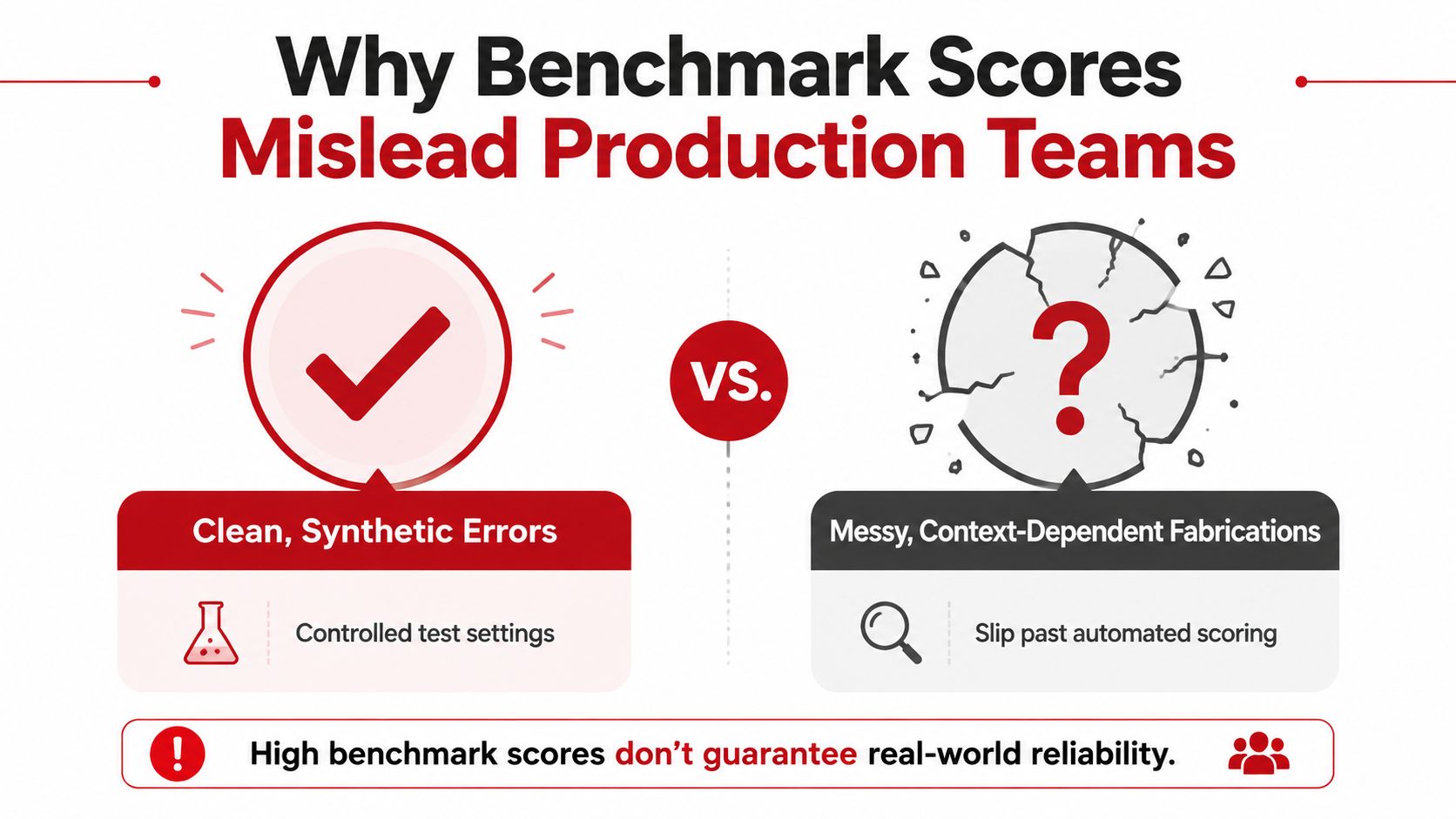
High benchmark accuracy is not the same thing as reliable AI hallucination detection. A detector can perform well on controlled examples and still miss a fabricated legal authority, a reversed clinical statement, or a plausible statistic that happens to fit the surrounding prose. In regulated work, the question isn't whether a model can label an output. It's whether your process can expose unsupported claims before a reviewer, client, patient, regulator, or court relies on them. The practical answer is layered verification. Treat automated scores as triage signals, not proof. Decompose the output into claims, retrieve authoritative evidence, compare independent judgments, preserve the reasoning trail, and escalate uncertainty according to the consequences of being wrong.
Why Benchmark Scores Mislead Production Teams
A strong benchmark result can still produce weak AI hallucination detection in production. Tests use defined prompts, labels, and evidence. Incoming documents contain missing context, ambiguous wording, stale sources, domain shorthand, and claims that become misleading only when combined.
The research supports caution. One evaluation of the lightweight HHEM classifier reported 82.2% accuracy and a 78.9% true-positive rate - for HHEM with non-fabrication checking, on that study's question-answering evaluation with Starling-LM-7B-alpha (Zhang, Wang & Meng, arXiv:2512.22416). A separate empirical study found that its own extraction-then-verification detector matched human annotation between 91.5% and 94.7% across five domains (Li et al., ACL 2024) - a measure of that method's agreement with human labels on that sample, not of detector reliability in general. Those results show useful classification performance, not a guarantee that a detector will catch every unsupported statement in legal, clinical, financial, or policy work.
The errors that controlled tests flatten
A controlled test asks whether a labeled claim is classified correctly. A production review asks whether the claim is supported in this jurisdiction, at this date, under this factual condition, and with this source interpretation. The second task includes retrieval, context, and judgment that a benchmark may not represent.
Three failure patterns regularly survive surface checks:
- Temporal inconsistency: A summary can combine an older policy with a later amendment, creating fluent text that never applied at one point in time.
- Misattributed expertise: A model can attach a statement to the wrong authority, paper, clinician, agency, or court. A search may confirm that the source exists while failing to show that it never made the claimed assertion.
- Statistical fabrication: A number can use familiar formatting and resemble related figures found online. Verification still requires checking the exact metric, population, period, and denominator.
A detector that misses one of these patterns can pass a benchmark while failing the review that matters. Teams should therefore treat benchmark performance as a threshold for triage, then test failure cases from their own documents and escalation paths.
Confidence adds another operational risk. A detector may express certainty even when its evidence is weak or its comparison is incomplete. The analysis of AI confidence scores and false certainty explains why confidence should not substitute for verification.
Production rule: Use a benchmark score to set review intensity, not to decide whether review is required.
The Four Stages Where Detection Fails
A dependable detector must process more than the final sentence. It needs to preserve the path from source material to claim, from claim to evidence, and from evidence to decision. The process-based PROBE benchmark treats hallucination detection as four measurable stages, claim decomposition, evidence finding, evidence evaluation, and hallucination localization, across 12,000 test cases in summarization, question answering, and style transfer, as published in Findings of ACL 2026.
Input parsing changes the problem before checking begins
A legal dictation transcript can contain a misheard party name, section reference, or procedural term. If the parser normalizes that error into clean text, every downstream component may verify the wrong claim. Medical notes create a related hazard when negation is missed. “No evidence of interaction” and “evidence of interaction” share vocabulary but carry opposite meanings.
Use domain dictionaries, preserve original text alongside normalized text, and mark uncertain spans instead of making corrections without feedback. Parsing should also retain document structure, including headings, footnotes, tables, speaker attribution, and date references. A detector that strips those signals may produce a precise answer to an incorrectly reconstructed input.
Claim extraction misses what the sentence implies
Explicit statements are comparatively easy to isolate. Conditional, comparative, and implied assertions are harder. “The treatment was tolerated better” implies a comparator and a measure. “The court adopted this reasoning” implies a holding, not merely a discussion.
Break compound sentences into atomic claims and label their type:
- Factual claim, such as an event, result, date, or quantity.
- Attribution claim, such as what a court, researcher, or regulator said.
- Causal claim, such as whether one event produced another.
- Interpretive claim, such as what a rule means in a specific context.
That classification helps select evidence and prevents a single “supported” label from hiding an unsupported causal or interpretive leap.
Retrieval can find related evidence instead of supporting evidence
Semantic search is useful when wording differs, but relevance isn't entailment. A research assistant might retrieve a paper about the same disease while overlooking that it studied a different population. A legal system might find a case with similar terminology from another jurisdiction, then treat it as authority for the current matter.
Store the exact retrieved passage, source date, jurisdiction, and document identifier. Require the evaluator to answer a narrower question: Does this passage support this claim, contradict it, or leave it unresolved? If the source only supports part of a sentence, split the sentence and flag the remainder.
Confidence scoring rewards familiar patterns
Models often assign high confidence to fluent, conventional language. That signal can be helpful, but it isn't evidence of truth. Detector rankings can also change dramatically with the evaluation criterion. One re-evaluation, published at EMNLP 2025, found performance drops of up to 45.9% for Perplexity-based detection and 30.4% for EigenScore - measured on Mistral with NQ-Open - when moving from ROUGE-style metrics to LLM-as-judge criteria, and found that simple response-length heuristics rivaled sophisticated detectors under the older metric (The Illusion of Progress, EMNLP 2025).
Calibrate scores against human-reviewed examples from your own domain. Log false negatives separately from false positives, because a detector that flags too much can be inconvenient, while one that misses plausible fabrications can be dangerous.
Building a Multi-Model Verification Chain
A single model can repeat the generator's assumptions, vocabulary, and blind spots. Independent reviewers create useful friction, but only if they receive distinct instructions and don't copy the first judgment.
A workable chain starts with a primary system that extracts atomic claims and identifies candidate evidence. A second reviewer receives the original claim and source passages, not just the first model's verdict. A third reviewer looks for contradictions, missing qualifiers, temporal conflicts, and unsupported attribution. This division matters because fact matching, contextual interpretation, and adversarial challenge are different jobs.
Give every reviewer a bounded responsibility
Model A should extract and classify claims. It can check structured fields, citation formats, dates, names, and direct source matches.
Model B should perform an independent contextual review. It should ask whether the evidence entails the claim, whether qualifiers were dropped, and whether the source applies to the relevant population, jurisdiction, or time period.
Model C should attack the proposed conclusion. It should search for contradictions, alternative interpretations, source conflicts, and claims that remain unsupported despite fluent wording.
A verification platform such as IamVera.AI can be configured around independent model review, adversarial challenge, live source checks, and an inspectable trail of confirmations, disagreements, corrections, and evidence. That kind of visibility is more operationally useful than a single final label because a reviewer can see why the system escalated the claim.
Use routing rules, not vague confidence
A starting threshold such as 0.7 can be a reasonable default, but no threshold should be treated as a universal standard. Confidence scores aren't comparable across models unless you calibrate them. Set thresholds using reviewed examples and risk tiers, then document what each route means.
A practical routing design looks like this:
- Clear support: The evidence directly supports the claim, the reviewers agree, and no contradiction appears. Record the source and proceed according to the document's risk tier.
- Borderline support: One reviewer identifies a missing qualifier or weak match. Send the claim to a stronger verifier or a human reviewer.
- Disagreement: Reviewers reach different conclusions. Preserve both rationales, retrieve additional evidence, and prevent automatic publication.
- Unavailable component: If a model, source connector, or evidence store fails, fail closed for high-risk outputs. Don't substitute a cached confidence score without labeling its limitations.
Run inexpensive local models for extraction and first-pass classification where appropriate. Reserve slower or proprietary systems for disputed claims and high-consequence documents. Caching source passages, batching independent claims, and processing low-risk material asynchronously can reduce latency without weakening the escalation path.
For a deeper treatment of independent model judgments, see multi-model verification and differences between model judgements.
Choosing Detection Methods That Generalize
No detector performs reliably across every task. Self-consistency exposes unstable answers, but repeated agreement does not establish factuality. Natural language inference scoring tests entailment, yet a model trained on general language relationships may miss legal citations, clinical qualifiers, or specialized terminology. Retrieval-augmented verification creates a source trail, but its result depends on retrieving the right material. LLM-as-judge can review nuanced context, while a judge trained on a similar distribution may reproduce the generator's blind spots.
The evaluation criterion matters as much as the detector. HalluScan, a 2026 single-author preprint studying compact (1.5-3B parameter) models, reported pooled AUROC of 0.688 for Self-Evaluation and 0.638 for Self-Consistency across 600 model-response pairs, and identified score-direction inversion in three of six methods (SemE, Judge, and RAV). The ranking also depends on aggregation: pooled AUROC ranks Self-Evaluation first at 0.688, whereas per-configuration macro-averaging ranks Self-Consistency first at 0.686 - a difference driven largely by SC's Commonsense score of 0.932, which the paper itself notes rests on only 5 positive samples - illustrating how evaluation design can change the apparent ranking of detection methods. In production, those findings require calibration, task-specific testing, and monitoring for reversed score meaning.
Comparison table
- Self-consistency — Failure Modes Caught: Unstable answers and internal variation; Generalization Strength: Moderate for repeatable reasoning tasks; Key Weakness: Consistent answers can still be wrong; Best Use Case: Triage for ambiguous prompts
- NLI-based scoring — Failure Modes Caught: Contradiction and unsupported entailment; Generalization Strength: Useful when domain language is represented; Key Weakness: Sensitive to jargon, negation, and legal or clinical nuance; Best Use Case: Comparing claims with supplied passages
- Retrieval-augmented verification — Failure Modes Caught: Missing evidence and source mismatch; Generalization Strength: Strong when authoritative sources are current and accessible; Key Weakness: Relevant retrieval isn't proof of support; Best Use Case: Research, policy, regulatory, and citation checks
- LLM-as-judge — Failure Modes Caught: Contextual inconsistency and nuanced omissions; Generalization Strength: Broad, but dependent on calibration and judge independence; Key Weakness: Correlated blind spots and criterion sensitivity; Best Use Case: Second-pass review with explicit rubrics
- Embedding similarity — Failure Modes Caught: Topic mismatch and distant evidence; Generalization Strength: Broad lexical coverage; Key Weakness: Similarity doesn't establish truth; Best Use Case: Candidate evidence retrieval
- Internal-representation methods — Failure Modes Caught: Signals inside the generating model; Generalization Strength: Potentially fast within a fixed model family; Key Weakness: Harder to transfer across models and deployments; Best Use Case: Real-time research and controlled environments
Match the method to the claim
Use retrieval when a claim requires external proof. Use contradiction checks when the output must remain consistent with a record. Structured rules handle dates, identifiers, citations, and arithmetic more predictably than a general detector. Human review remains necessary when the claim depends on professional judgment, unresolved source conflict, or a high-impact interpretation.
A layered workflow should assign methods according to failure risk, not popularity in benchmark tables. Run inexpensive checks broadly, then escalate claims that produce conflicting signals, weak evidence, or domain-specific uncertainty. That structure is how teams find the minority of failures automated scoring misses without sending every response to manual review.
The HalluMix benchmark (Emery et al.) addresses fragmented evaluation across domains and formats, with marked performance differences between short and long contexts. Its practical implication is direct: test the complete workflow on the documents your organization processes, including long-form material and unfamiliar input structures, rather than adopting a detector because it achieved a strong public result. Recheck performance after model, corpus, prompt, or retrieval changes.
Grounding Claims in Live Sources
A detector can say that a statement looks suspicious. Grounding verification asks whether a verifiable source supports the exact statement. That distinction separates anomaly detection from evidence-based review.
Start by converting the output into atomic claims. For each claim, capture the subject, predicate, qualifiers, date, jurisdiction, population, and requested level of certainty. Then search authoritative repositories, such as regulatory filings, clinical trial registries, official guidance, case law databases, or the source documents supplied by the user.
Evidence needs an audit trail
A source link alone isn't enough. Preserve the retrieved passage, document title, issuing body, publication or update date, and the location of the supporting text. Store the claim as it appeared in the generated output, not only a rewritten version, because later reviewers need to understand what was asserted.
Classify the result explicitly:
- Supported: The source directly entails the claim, including relevant qualifiers.
- Partially supported: The source supports only a portion of the claim, or the generated wording is broader.
- Contradicted: The source states something materially different.
- Unresolved: The source is unavailable, ambiguous, outdated, conflicting, or insufficiently specific.
Handle imperfect sources deliberately
Paywalled evidence shouldn't be replaced with a secondary summary. Record the access limitation and route the claim to someone with authorized access. If sources conflict, preserve both versions and identify the conflict instead of selecting the more convenient passage.
Outdated material requires date-aware retrieval. A current claim may be correct under a new rule and wrong under the version in force when an event occurred. For clinical or financial content, source provenance and update status should be visible to the reviewer before approval.
Automated detection can prioritize review by identifying unusual phrasing, unsupported citations, or disagreement among models. It shouldn't turn unresolved uncertainty into “probably true.” The evidence trail should make it easy for an auditor to trace each important statement to its source, or to see that the statement remains unverified.
Handling Confidential Documents Without Sacrificing Verification
The documents most likely to require careful checking often contain the information teams can't send freely to external services. Patient records, privileged legal communications, internal investigations, and proprietary financial models create a direct tension between verification depth and data governance.
An on-premise or private deployment keeps content within a controlled environment and supports local parsing, claim extraction, and initial review. The trade-off is reduced model diversity if the strongest independent reviewers aren't available locally. Air-gapped workflows can also introduce latency and require teams to maintain model versions, retrieval indexes, access controls, and monitoring themselves.
Separate sensitive content from verification context
Pseudonymization can replace names, account identifiers, addresses, and other sensitive values before an external check. For this type of workflow, the re-identification mapping should remain inside the controlled environment, while the outbound gate should block transmission when sensitive fields cannot be removed or transformed with sufficient assurance.
Differential privacy techniques can support aggregate testing without exposing individual records, but they aren't a universal solution for document-level fact checking. They may obscure the exact detail a reviewer needs to verify. Use them for evaluation and analytics where appropriate, not as a substitute for source-grounded review of a specific patient or matter.
Synthetic documents offer another valuable layer. Generate representative records with invented identities and controlled hallucination patterns, then test parsers, retrievers, escalation rules, and logging without touching production data. Keep synthetic tests separate from real-case validation, since synthetic language may not reproduce the ambiguity found in live records.
Privacy controls shape the detector you can safely deploy. Treat that constraint as an architecture decision, not a late compliance check.
Document which steps stay inside the private boundary, which may use anonymized excerpts, and what happens when redaction confidence is low. Teams managing secrets and credentials should also review secrets management as an AI workflow security layer before connecting verification services to regulated systems.
Your Detection Workflow Implementation Checklist
Build the workflow as a control, not as a helpful sidebar that users can skip. Start with an inventory of output types, their business owners, the authoritative sources they require, and the consequence of an undetected error.
Define the review route
Use risk tiers rather than one global rule:
- Low-risk internal summaries: Apply automated claim extraction, retrieval checks, and independent model review. Make unsupported claims visible to the author before distribution.
- Operational guidance: Require source grounding and a named approver, especially when the text affects customers, employees, or regulated processes.
- High-risk legal, clinical, compliance, or external-facing documents: Require human review of material claims, citations, exceptions, and unresolved conflicts before release.
Example triggers can be useful starting points, but they need local calibration. A confidence score below 0.85, failed source grounding, or cross-model disagreement above 15% may route a claim to a reviewer, yet those thresholds should be validated against your own false-positive and false-negative logs rather than adopted as universal truth.
More articles on this subject are collected in the AI verification overview.
Sources and references
- Hallucination Detection and Evaluation of Large Language Model
- HalluScan: A Systematic Benchmark for Detecting and Mitigating Hallucinations in Instruction
- HalluMix: A Task-Agnostic, Multi-Domain Benchmark for Real
- The Dawn After the Dark: An Empirical Study on Factuality Hallucination in Large Language Models
- The Illusion of Progress: Re-evaluating Hallucination Detection in LLMs
- PROBE: PROcess-Based BEnchmark for Hallucination Detection
- HaluEval: A Large-Scale Hallucination Evaluation Benchmark for Large Language Models
- HalluMix benchmark
Sources: Key claims are attributed to Zhang, Wang & Meng (arXiv:2512.22416) on HHEM classifier accuracy, Li et al. (ACL 2024) on extraction-then-verification agreement with human annotation, and the PROBE process-based benchmark (Findings of ACL 2026) on four-stage detection.