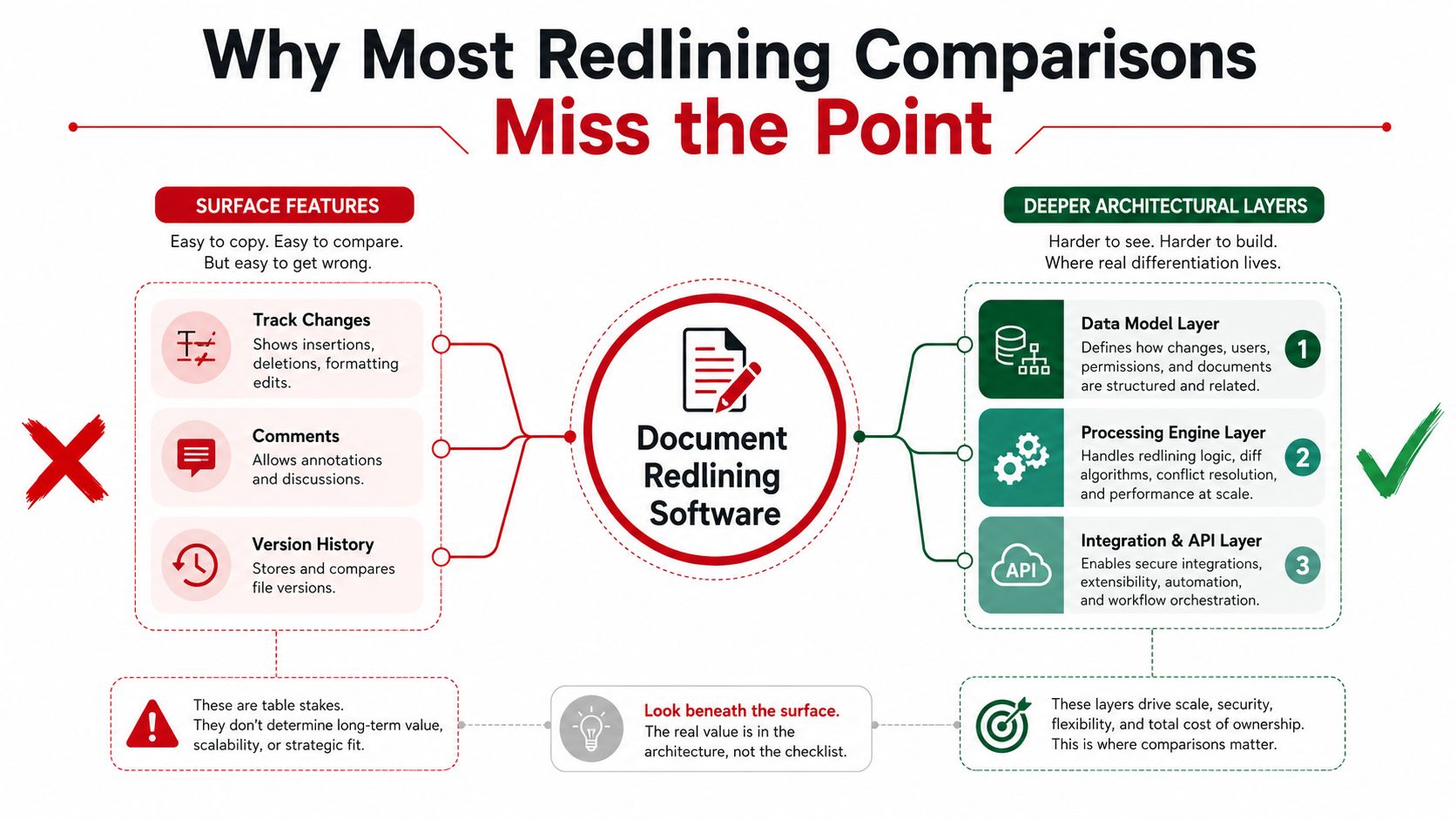
Organisations evaluating document redlining software should assess four separate layers before uploading sensitive files. First, test comparison accuracy, including whether the system reliably captures inserted, deleted, moved, and reformatted text. Second, verify workflow and output fidelity, especially whether the result remains a natively editable document with usable tracked changes. Third, inspect the data-processing architecture, including where document text is parsed, whether readable content reaches third-party providers, what is retained, and how deletion works. Fourth, test verification, audit, and human approval controls so the organisation can establish who reviewed, changed, approved, exported, or deleted material. Those four layers usually determine whether a platform is suitable for confidential and regulated work. survey coverage and redlining analysis
Selecting document redlining software by counting features is a common buying mistake. Track changes, comments, version history, Word integration, and AI review options all matter. They do not, however, answer the question that matters most for legal, healthcare, compliance, and other regulated teams: what happens to confidential document text once a file is uploaded for comparison or AI-assisted review.
For regulated and professional workflows, document redlining software should be evaluated as both a document comparison system and a document-governance system. Two products may produce similar visual output while relying on very different comparison engines, storage models, subprocessors, retention practices, audit records, and human approval controls. A sound evaluation therefore starts with architecture and governance, then moves to workflow fit, output fidelity, and review quality.
What Matters Most in Document Redlining Software
Most comparison articles treat document redlining software as a visible feature set. If two platforms display insertions, deletions, comments, and version history, they can appear interchangeable. That assumption fails once a buyer asks where the document is processed, which services receive its text, how long derived data remains available, and whether the final output is a native editable document or only a rendered comparison layer.
The historical background is brief but useful. Redlining began as a manual comparison practice in which reviewers marked changes between drafts by hand, and early software simply automated that exact-difference task (history of document comparison). Modern platforms often add cloud collaboration, AI analysis, storage, indexing, and workflow controls on top of the comparison engine. That is why a product that looks familiar on screen may behave very differently once a confidential file enters its processing pipeline.
Why the interface is not the system
A polished interface can conceal several material differences:
- Processing location: The document may be compared locally, processed in a vendor-controlled environment, or sent to third-party APIs.
- Data representation: The service may retain the original file, extracted text, embeddings, metadata, logs, or temporary processing copies.
- Output type: Some engines preserve native Word tracked changes, while others create a visual comparison layer that is not equivalent to editable redlining.
- Control boundaries: A product may offer user permissions without providing document-level isolation, retention controls, or a complete audit record.
The security question is not limited to whether data is encrypted in transit. Buyers should determine whether contract text reaches the provider in readable form, whether zero-retention commitments cover metadata and derived artifacts, and which certifications and encryption controls apply. For AI governance and system-risk terminology, the more durable reference point is NIST guidance on generative AI risk management and prompt injection rather than product marketing claims (NIST AI Risk Management Framework: Generative AI Profile, NIST prompt injection glossary entry).
Practical rule: Treat the redlining interface as the visible tip of a processing pipeline. Evaluate the pipeline, not just the markup.
What Happens to Your Document After You Upload It?
For regulated teams, the most important question is often not what the markup looks like, but what happens between upload and export. A useful evaluation framework is to trace the document through each stage of the redlining data path:
Original document → extraction/parsing → comparison or AI analysis → model/provider processing → temporary or persistent storage → reviewer decision → tracked changes/export → logs/audit record
That sequence helps a buyer separate the visible review experience from the underlying processing and governance model.
A practical data-path framework
- Original document upload — What data may be present: Full source file, filename, metadata, user identity, matter context; What to ask the vendor: Where is the original file received and processed first? Is it encrypted before any server-side handling?; Evidence to request: Data-flow diagram, architecture overview, encryption documentation; Potential issue: Confidential text may enter a vendor environment before the buyer understands where it goes
- Extraction and parsing — What data may be present: Extracted text, document structure, comments, tracked changes, styles, tables, properties; What to ask the vendor: Is readable text extracted? Are tables, comments, and metadata preserved or transformed?; Evidence to request: Technical description of parsing flow, supported-format documentation; Potential issue: Parsed text may persist separately from the original file
- Comparison or AI analysis — What data may be present: Diff outputs, clause segments, prompts, model inputs, semantic summaries; What to ask the vendor: Is this exact document comparison, semantic review, or both? Which engine performs each task?; Evidence to request: Product documentation, explanation of comparison method, source-linked review examples; Potential issue: A buyer may mistake semantic analysis for exact comparison
- Model or provider processing — What data may be present: Prompt content, extracted passages, user instructions, AI outputs; What to ask the vendor: Is readable document text sent to third-party AI or model providers? Under what terms?; Evidence to request: Subprocessor list, model-provider terms, contractual training restrictions; Potential issue: Sensitive language may leave the primary platform boundary
- Temporary or persistent storage — What data may be present: Source files, extracted text, embeddings, cache, logs, backups, exports; What to ask the vendor: What is stored, for how long, and in which systems? What does zero retention cover exactly?; Evidence to request: Retention schedule, deletion policy, contractual definitions; Potential issue: Zero-retention claims may exclude logs, metadata, or derived artifacts
- Reviewer decision and approval — What data may be present: Suggestions, accepted or rejected changes, comments, reviewer identities; What to ask the vendor: Can the system show who reviewed and who approved each change?; Evidence to request: Audit log sample, role and permission documentation; Potential issue: An organisation may be unable to reconstruct the approval path later
- Tracked changes and export — What data may be present: Native DOCX output, rendered comparison, comments, formatting, accepted edits; What to ask the vendor: Does the export preserve native Word tracked changes and remain editable?; Evidence to request: Sample exports, test files, workflow demonstration using real documents; Potential issue: A rendered overlay may not support downstream legal negotiation
- Logs and audit record — What data may be present: Usage events, uploads, exports, deletions, access events, suggestion history; What to ask the vendor: What events are logged, how long are logs retained, and can administrators inspect them?; Evidence to request: Audit documentation, admin screenshots, event schema; Potential issue: Logs may be incomplete for evidentiary or compliance purposes
This framework is useful because it distinguishes four separate evaluation questions that are often collapsed into one purchasing decision:
- Can the system detect the right changes?
- Can the team work with the output in its normal review process?
- What happens to the document and its derived data during processing?
- Can the organisation later prove what happened and who approved it?
Those questions should be answered independently. A tool may be strong in one area and weak in another.
How to Evaluate Workflow Fit and Output Fidelity
A feature list cannot predict operational success. The relevant question is whether the platform's comparison engine, collaboration model, document formats, and deployment controls align with the work your team actually performs.
The market is increasingly segmented into distinct product categories:
- Exact document comparison engines focus on structural precision, including additions, deletions, moved text, formatting changes, and difficult tables.
- Word-integrated tools place suggestions, comments, and AI assistance inside the word processor where negotiation often occurs.
- Cross-format comparison platforms compare Word, PDF, Excel, and PowerPoint files when a workflow spans multiple formats.
- AI-assisted review systems identify semantic changes, gaps, and clause-level concerns, often producing recommendations rather than a definitive legal blackline.
- Browser-based or self-hosted engines emphasise deployment control, editability, and auditability.
An open-source browser implementation illustrates why architecture and output format belong in the same buying discussion. It states that it can preserve native Word tracked changes and detect insertions, deletions, moves, and formatting changes, with improved table handling, browser-only execution, self-hosting, and auditability options (open-source DOCX redlining engine). That is materially different from a tool that only paints differences over a rendered document.
AI can accelerate early review by surfacing likely changes and reducing the amount of text a reviewer must inspect at the outset. It also introduces a different failure mode. A semantic system can misinterpret a qualification, overlook a subtle obligation, or suggest language that appears plausible but does not reflect the organisation's approved position. AI assistance is therefore useful as a review layer, but not as an unexamined substitute for exact comparison or professional sign-off.
A video demonstration can help teams understand the interaction model, but it should not replace testing with their own confidential document controls and representative files.
- Exact document comparison engine — Best at: Precise structural comparison across versions; Main limitation to test: Collaboration and AI interpretation may be limited or external; Typical fit: Execution-ready contracts, evidence, controlled approvals
- Word-integrated AI reviewer — Best at: Drafting support and clause-level suggestions inside Word; Main limitation to test: Native output, logging, and processing boundaries must be tested carefully; Typical fit: Contract review where Word remains the centre of negotiation
- Cross-format comparison platform — Best at: Comparing files across multiple office formats; Main limitation to test: Conversion and rendering differences can affect fidelity; Typical fit: Multi-format deal, audit, or compliance workflows
- CLM with redlining module — Best at: Routed approvals and contract record integration; Main limitation to test: Comparison depth and export fidelity vary by platform; Typical fit: Teams already operating in a mature CLM environment
- Browser-based or self-hosted DOCX engine — Best at: Controlled deployment and editable DOCX output; Main limitation to test: Broader workflow features may depend on surrounding systems; Typical fit: Security-sensitive organisations with deployment constraints
Test the workflow, not the demo
A solo reviewer may value speed and a clean Word experience. A deal team may require identity controls, comment ownership, conflict handling, unresolved-comment reporting, and a reliable final-version process. A compliance team may care less about live negotiation and more about whether every change can be reproduced and reviewed later.
Use a representative test set that includes difficult tables, formatting changes, comments, moved clauses, and documents exported from the systems your organisation already uses. Ask reviewers to compare the generated output against a trusted human comparison, then inspect not only missed changes but also false positives that create review noise.
A tool that performs well on a simple bilateral agreement may not fit a large transaction with many reviewers. Conversely, an enterprise platform can impose unnecessary workflow friction on a small practice. The correct choice is contextual. Workflow fit outweighs feature volume when the product becomes part of daily review.
How to Assess Security Architecture and Data Controls
Security claims in software comparisons often stop at certification badges and encryption at rest. Those controls matter, but they do not answer the questions that arise during document ingestion, extraction, AI processing, temporary storage, indexing, export, and deletion.
Start with the document path. Does the original file leave the user's environment? Is text extracted before comparison? Does the platform send readable content to a model provider? Are prompts, outputs, embeddings, filenames, user identities, and usage events retained separately? Does a deletion request remove source files and derived data, or only the visible document record?
The phrase zero data retention also requires precision. It may refer only to an external model provider's handling of prompts, while the redlining vendor retains the uploaded document, extracted text, metadata, logs, or cached output. Buyers should request the contractual definition, the retention period for each data class, and the deletion process after account cancellation. In regulated contexts, records governance and retention should be tested against authoritative frameworks rather than accepted at the level of a marketing promise. For Europe and the UK, that means storage-limitation guidance that personal data should be kept no longer than necessary for its purpose, with defensible deletion or anonymisation procedures (EDPB data protection by design and by default guidelines, EDPB data protection basics, ICO storage limitation guidance). In the United States, buyers may also cross-check sector-specific records guidance where relevant, for example HHS records management policy and a CMS records retention example.
- Vendor-hosted AI redlining service — Encryption standard: Verify the exact standard and where it applies; Data retention policy: Require separate terms for files, text, metadata, logs, and derived data; AI training opt-out: Confirm whether opt-out is contractual and applies to subprocessors; Audit trail granularity: Confirm whether it records suggestions, approvals, edits, and exports
- Self-hosted comparison engine — Encryption standard: Controlled by the deploying organisation; Data retention policy: Set by internal infrastructure and backup policies; AI training opt-out: No external model training unless an AI service is added; Audit trail granularity: Depends on the surrounding application and identity system
- CLM redlining module — Encryption standard: Verify storage and transport controls across the full CLM stack; Data retention policy: Review lifecycle retention, archives, and deletion exceptions; AI training opt-out: Establish whether optional AI services have separate terms; Audit trail granularity: Often tied to records, approvals, and user actions, but validate granularity
- Word-integrated AI tool — Encryption standard: Confirm add-in, API, and model-provider boundaries; Data retention policy: Ask whether document text persists outside the Word session; AI training opt-out: Confirm training restrictions for the vendor and model providers; Audit trail granularity: Test whether changes and comments are logged independently of Word
- Browser-local or privacy-preserving workspace — Encryption standard: Determine what leaves the browser and under which gate; Data retention policy: Inspect local restoration, server logs, and session cleanup; AI training opt-out: Confirm policy for any external analysis route; Audit trail granularity: Verify whether validated edits and verification events are inspectable
A useful contrast is provided by local AI and cloud privacy architecture, which frames the core trade-off clearly: cloud processing may simplify deployment and provide powerful models, while local or privacy-preserving designs can reduce exposure by controlling what leaves the document environment.
Controls regulated teams should verify
- Isolation: Can one customer, matter, workspace, or document be technically separated from another?
- Identity: Are permissions role-based, document-specific, and integrated with organisational identity management?
- Auditability: Does the record show who uploaded, reviewed, changed, accepted, rejected, exported, or deleted content?
- Subprocessors: Can the vendor identify every service that receives document text or metadata?
- Retention: Can administrators set or enforce deletion rules, including backups and derived content?
- Model governance: Does the AI provider train on prompts, documents, or outputs, and can that use be prohibited?
Healthcare and legal teams should not accept “enterprise security” as a complete answer. They need evidence that maps the vendor's architecture to their confidentiality, privilege, records-management, and regulatory obligations.
Exact Redlining Versus AI Meaning-Level Review
Exact redlining and meaning-level review answer different questions. Exact document comparison records every added, removed, moved, or formatting-altered element. Meaning-level or semantic AI review attempts to identify substantive changes, omissions, gaps, or shifts in intent while reducing cosmetic noise.
A strict diff is the safer choice when the approval record must show precisely what changed. That includes execution-ready contracts, filings, evidence packages, litigation-related document preservation, newsroom verification, and compliance records where a small wording or formatting change may matter. The output can be noisy, but the noise is visible and reviewable.
Meaning-level review is more useful earlier in the lifecycle. A policy owner updating a document may want to know whether obligations, exceptions, or responsibilities changed, rather than inspect every punctuation adjustment. A legal reviewer may use semantic analysis to prioritise clauses before applying or validating exact tracked changes.
These functions should not be treated as equivalents. Semantic review is useful for prioritisation and interpretation. Exact comparison is required when the organisation must establish precisely what changed. In mature workflows, the two can complement one another: semantic review can narrow attention, while exact document comparison provides the approval record.
- Exact redlining — Primary strength: Complete visible record of file differences; Main limitation: Can overwhelm reviewers with cosmetic changes; Appropriate control: Human review of the marked output
- Meaning-level AI review — Primary strength: Prioritises intent, gaps, and substantive issues; Main limitation: May miss subtle language or misread context; Appropriate control: Source-linked explanations and professional validation
- Combined workflow — Primary strength: Uses AI for triage and strict diff for approval; Main limitation: Adds process complexity and integration requirements; Appropriate control: Separate stages with clear authority for final changes
A 2026 comparison guide makes the distinction explicit: AI document comparison can help with meaning, gaps, and multi-file review, but exact redlines still require a purpose-built diff or document-comparison tool. Its practical advice is to use a diff whenever every added, removed, or moved word matters (AI document comparison guidance).
A decision rule for teams
Use meaning-level analysis for prioritisation, not as proof that no exact change occurred. Use strict comparison for approval, execution, and audit evidence. If an AI system proposes edits, require the reviewer to inspect the underlying source passage and the resulting native document markup.
Uploaded documents can also contain text that is ordinary content to a human reader but may be interpreted by an AI system as an instruction. That is the practical concern behind indirect prompt injection in document workflows. The relevant architectural question is whether the system separates document content, model interpretation, and authorised system action, rather than allowing model output to trigger consequential changes without review. Teams should understand indirect prompt injection in documents and websites before allowing models to act on untrusted files. NIST's terminology is useful here because it defines prompt injection as an attack that exploits untrusted input placed into a higher-trust prompt context (NIST prompt injection glossary entry).
The strongest architecture is often layered rather than universal. One engine detects exact differences, another helps interpret them, and a controlled workflow requires human approval for any change that leaves the organisation.
Vendor Due Diligence Checklist
A serious procurement process should force vendors to explain how their system handles confidential documents in practice, not merely how the interface looks in a demonstration.
- Where is the original document processed? — Why it matters: Determines which environment first receives confidential text; Evidence to request: Data-flow diagram, deployment diagram; Red flag: Vague answer such as “secure cloud” with no architectural detail
- Is readable document text sent to third-party AI or model providers? — Why it matters: Establishes whether sensitive text leaves the primary vendor boundary; Evidence to request: Subprocessor list, model-provider terms, DPA language; Red flag: Vendor cannot identify providers or contractual restrictions
- Which subprocessors receive document text or metadata? — Why it matters: Reveals who handles source files, logs, analytics, and storage; Evidence to request: Current subprocessor register, categories of shared data; Red flag: Incomplete or non-specific list
- What exactly does “zero retention” cover? — Why it matters: Prevents ambiguity about files, prompts, outputs, metadata, and logs; Evidence to request: Written definition in contract or policy; Red flag: Marketing claim with no data-class breakdown
- Are prompts, outputs, embeddings, caches, and logs retained? — Why it matters: Derived data can be sensitive even if source files are deleted; Evidence to request: Retention schedule by data class; Red flag: Only source-file retention is discussed
- Can administrators verify deletion? — Why it matters: Controlled environments often require evidence, not just promises; Evidence to request: Admin controls, deletion workflow, audit confirmation; Red flag: No way to confirm deletion beyond support request
- Is customer data used for model training or service improvement? — Why it matters: Affects confidentiality, privilege, and downstream reuse risk; Evidence to request: Contractual training restrictions, opt-out terms; Red flag: Opt-out is informal, limited, or does not cover subprocessors
- Are native Word tracked changes preserved? — Why it matters: Many legal workflows depend on editable DOCX output; Evidence to request: Real sample output from representative files; Red flag: Output is only a rendered view or flattened export
- Can the system reproduce who accepted or rejected a change? — Why it matters: Approval traceability is essential for audit and dispute reconstruction; Evidence to request: Audit log sample, user action history; Red flag: Actions cannot be tied clearly to named users
- Can source passages be inspected behind AI recommendations? — Why it matters: Reviewers need to distinguish observed text from generated suggestion; Evidence to request: Product demo with source-linked explanation; Red flag: AI outputs appear authoritative but cannot be traced back
- What happens after account termination? — Why it matters: Retention, backup, export, and deletion obligations continue beyond active use; Evidence to request: Offboarding process, retention and deletion policy; Red flag: Contract is silent on backups, derived data, or residual access
- What controls exist for document-level or matter-level isolation? — Why it matters: Sensitive matters may require narrower separation than tenant-level controls; Evidence to request: Access-control model, technical isolation description; Red flag: Permissions exist only at broad workspace level
This checklist is often more useful than a generic feature comparison because it translates security, privacy, and auditability into concrete procurement questions.
Questions to Ask Before Choosing a Platform
The due diligence checklist above should drive most procurement conversations. This final review step is narrower. It helps teams pressure-test whether a vendor can explain the system clearly, show evidence quickly, and handle representative files without evasive answers.
Focus on three follow-up checks:
Ask for one complete document journey
Request a single walkthrough from upload to export using a representative file. The vendor should be able to show where the file is processed, whether readable text is extracted, which services receive it, what is retained, and what the exported output looks like.
Ask the AI to show its work
If the platform makes semantic suggestions, require source-linked explanations. Reviewers should be able to inspect the underlying passage, compare it to the proposed change, and confirm that the recommendation has not blurred observation with generation.
Ask how the system fails
Test large or structurally difficult files from your own environment. Ask what happens if parsing breaks, a comparison times out, a reviewer loses access, a document is superseded, or an administrator later needs to reconstruct the final approved version. Failure handling often reveals more about product maturity than the happy-path demo.
Red flags include answers that rely on marketing labels, refusal to identify subprocessors, unclear ownership of model outputs, and demonstrations that avoid real files. A serious vendor should be able to explain its boundaries without turning every question into a sales promise.
Best Fit by Use Case
A legal team handling recurring negotiations should prioritise native editability, exact comparison, permission granularity, and playbook alignment. The team may benefit from AI-assisted triage for standard agreements, but the final counterparty document should preserve tracked changes and support ordinary accept or reject actions. Test the product with multiple reviewers, unresolved comments, competing versions, and the organisation's own fallback language rather than relying on a generic demo.
Healthcare organisations should begin with the data path, not the clause library. Confirm whether sensitive text leaves the controlled environment, whether pseudonymisation or local processing is available, how retention applies to source and derived data, and whether the vendor can document its subprocessors and access model. A feature-rich cloud tool is not automatically unsuitable, but its architecture must be defensible for the records being processed.
Compliance teams revising policies or maintaining audit evidence should prioritise reproducibility and immutable review history over conversational convenience. Meaning-level analysis can help locate substantive changes, while exact comparison should establish the final evidence of what changed. The system should preserve reviewer identity, source versions, approvals, exports, and any AI suggestions that influenced the controlled edit.
For teams whose work spans legal research, compliance analysis, and controlled document editing, IamVera.AI's legal research and compliance use cases describe a model that combines multi-model verification, source inspection, privacy-preserving document handling, and a DOCX workspace with controlled editing. It should be evaluated alongside dedicated exact-comparison engines and CLM platforms, not presented as a universal replacement for either.
Key Takeaway
The central conclusion is straightforward. Document redlining software is a document-processing and governance decision with a productivity component, not simply a faster version of Word. Buyers should first determine whether they need exact document comparison, semantic document review, or a controlled combination of both. They should then verify where document data goes, what is retained, what remains natively editable, and whether the organisation can later prove who reviewed and approved each change.
For confidential and regulated workflows, the most reliable evaluation model is to assess four layers independently: comparison accuracy, workflow and output fidelity, data-processing architecture, and verification or audit controls. A platform that appears strong on screen may still be unsuitable if its processing model, retention terms, or approval record do not meet the organisation's obligations.
More articles on this subject are collected in the AI privacy and GDPR overview.
Sources and references
- NIST AI Risk Management Framework: Generative AI Profile
- prompt injection - Glossary
- EDPB data protection by design and by default guidelines
- Data protection basics | Data protection guide for small business
- Principle (e): Storage limitation
- survey coverage and redlining analysis
- Redline Document Comparison
- Generative AI’s Growing Strategic Value for Corporate Law Departments
Sources: AI governance and prompt-injection terminology is attributed to NIST; data protection and retention principles draw on EDPB and ICO guidance; redlining history and market context reference Spellbook, RedlineDCS and Everlaw.