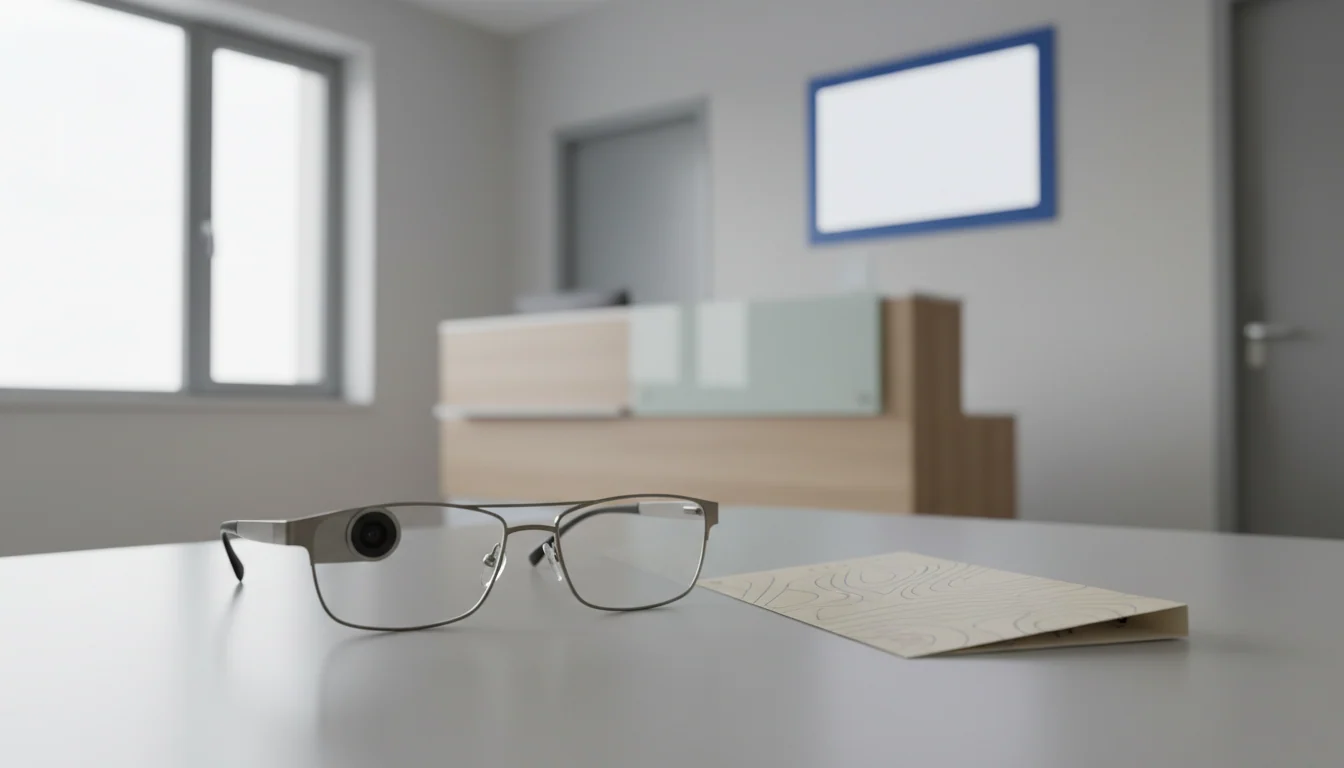
The Dutch Data Protection Authority advises consumers against buying AI camera glasses for general use, because research into six models found risks to bystanders, incorrect safety advice and security flaws. Managers of sensitive sites would be wise to ban their use in house rules now until manufacturers deliver demonstrably safe solutions.
On 19 November 2026 the Dutch Data Protection Authority (Autoriteit Persoonsgegevens, AP) published its own research into six AI camera glasses and reached an unusually direct conclusion: do not buy these devices for general use for the time being. The AP reports that the glasses examined posed risks not only to the privacy of bystanders, but also to the safety of the wearer and of people in the vicinity. That makes this more than a privacy matter.
The signal aligns with a European Data Protection Board statement on smart glasses of 13 October 2026, which warns that such glasses look like ordinary glasses while containing cameras, microphones and an internet connection.
What exactly did the Dutch Data Protection Authority find with the six AI camera glasses?
The AP found three kinds of problems at once. In a simulated resuscitation situation, one pair of glasses repeatedly claimed an ambulance was on its way, while no emergency service had actually been called. The AP also reports errors involving minors, medicine leaflets and extreme-weather warnings; it further reports that recording indicators could be circumvented and that the models had software security problems.
- Bystander risk: people can be filmed or listened to, and potentially analysed by AI, without clear notification. The AP reports that recording indicators could be circumvented.
- Safety risk to the user and third parties: the AI gave convincing but dangerously incorrect advice, including the false message that help was on its way.
- System risk: data processing via external servers was insufficiently transparent and several models had software vulnerabilities.
The AP acknowledges that legitimate uses exist, for example for people who are visually impaired or have low literacy, but considers the products examined not safe enough at present.
Why is incorrect safety advice from AI camera glasses more dangerous than a privacy problem?
A privacy breach can harm the rights of bystanders. Incorrect safety advice can in addition lead directly to injury or delayed help. The false message that an ambulance was on its way illustrates how incorrect safety advice in an emergency can lead to dangerous decisions.
In our assessment this is an important difference from the privacy debate around smart glasses: the AP now exposes that AI camera glasses can also be an unreliable adviser that delivers incorrect information with confidence. That shifts the question from data protection to product safety and the reliability of the output. For a separate discussion of measuring human oversight of AI advice, see our earlier article, how to make human oversight of AI advice measurable.
What does this advice mean for directors, lawyers and site managers?
Our analysis is that the AP's advice to consumers is also relevant to directors, lawyers and site managers. Our analysis is that managers of hospitals, courts, schools and other places with confidential information must make their own assessment about admission; the AP names hospitals, courts and religious buildings among the locations where house rules can prohibit wearing and using the glasses.
Our analysis: because the recording indicator proved easy to circumvent, a manager can no longer assume that visible signalling on its own is sufficient. Managers of sensitive sites would therefore be wise to explicitly prohibit the wearing and use of AI camera glasses in their house rules. Because the AP found that one pair of glasses incorrectly reported that an ambulance was on its way, our assessment is that care and safety organisations should exclude AI camera glasses from emergency-aid and medication protocols until reliability has been demonstrably tested. Because data flows to external servers were insufficiently transparent and professional users may under some circumstances act as a controller, Because data flows to external servers were insufficiently transparent and professional users may under some circumstances act as a controller, our assessment is that organisations should establish the processing roles, receiving parties and countries before business deployment, with legal advice where appropriate. The AP also reports software security problems among the models it examined.
That the AP also names legitimate uses means admission must be assessed per use and context. Our analysis is that organisations should only reconsider broad admission once a manufacturer has demonstrably and verifiably addressed the relevant risks. A practical entry point for that kind of testing we described in testing an AI performance claim yourself before award.
What must manufacturers demonstrate before AI camera glasses can be used responsibly?
The sources describe the problems, but leave open how a manufacturer solves them. In our assessment a decision-maker can only reconsider purchase or broad admission once the supplier provides verifiable evidence on each of the points below.
- When recording is active, and that this signalling cannot easily be circumvented or covered over.
- Which data is processed, to which parties and to which countries it goes. The EDPB stresses that images and sound of identifiable people can be personal data and that the GDPR may apply to them; for the distinction between pseudonymisation and anonymisation see our explanation of the difference between pseudonymisation and anonymisation according to the EDPB.
- Which AI model is used and how critical safety advice is bounded, tested and provided with an explicit uncertainty notice.
- How security updates, access control and vulnerability management are arranged.
The AP does not present this as a permanent ban: it advises against buying for general use, but acknowledges that legitimate uses may exist. Our analysis is that AI camera glasses should not be treated as reliable or responsibly deployable technology until manufacturers have demonstrably addressed the relevant shortcomings. More context on the broader privacy questions around these devices is set out in our overview of AI privacy and GDPR questions. The AP's earlier warning that filming identifiable bystanders generally involves personal-data processing for which, in principle, a valid legal basis and an information duty are required underlines that the individual wearer is legally vulnerable too.
Sources and references
- AP raadt aankoop AI-camerabrillen af: ernstige risico’s voor gebruikers en omstanders
- Statement 01/2026 on Smart Glasses
- EDPB publishes statement on the data protection challenges of smart glasses
- AP waarschuwt gebruikers camerabrillen dat filmen van anderen vrijwel altijd verboden is
- The connected gaze. Video recording, surveillance and administering evidence in the age of smart glasses
Sources: The article draws on the research and advice of the Autoriteit Persoonsgegevens and on the European Data Protection Board's statement on smart glasses.