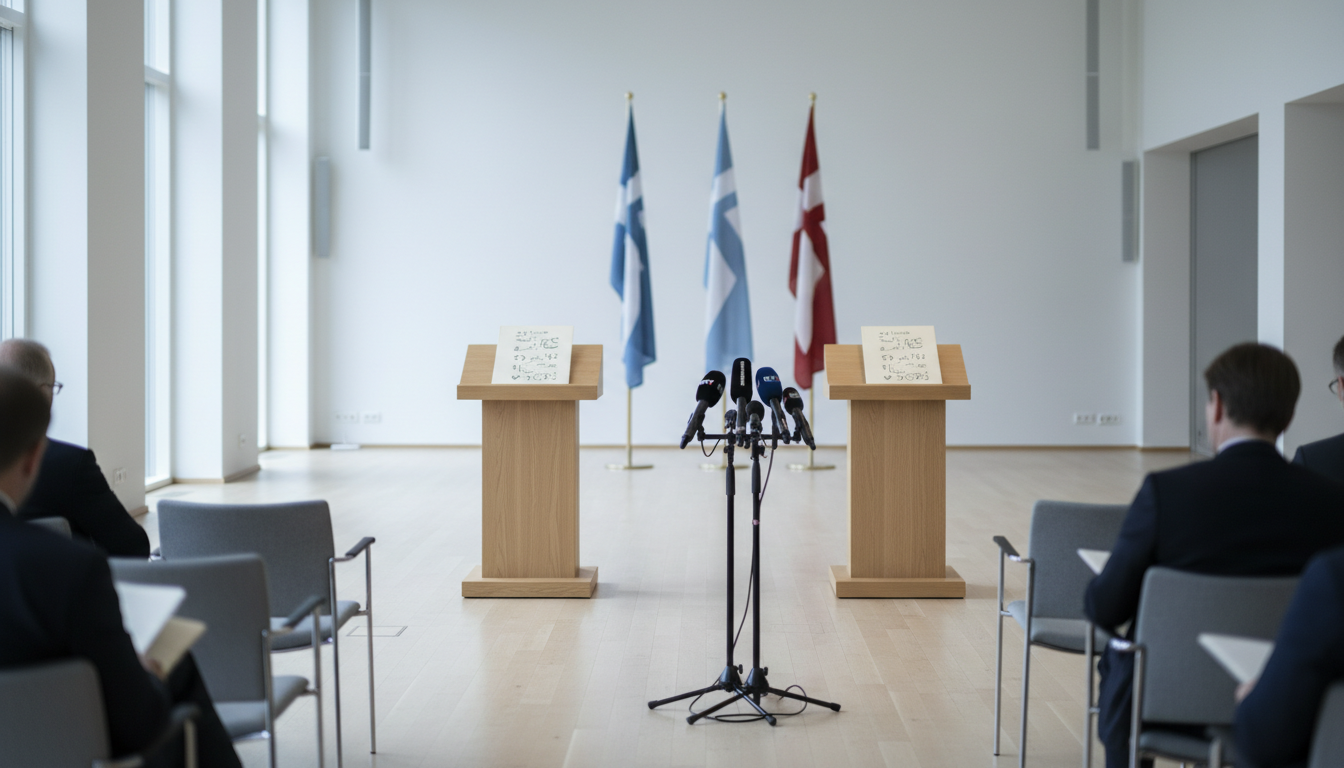
Finland and Norway launched a non-binding international call on 21 September 2026 for mandatory pre-deployment tests, independent evaluation, coordinated standards and a possible UN body. Decision-makers should not wait, but ask their AI providers now about test scope, evaluator independence and incident-reporting arrangements.
Finnish President Alexander Stubb and Norwegian Prime Minister Jonas Gahr Støre presented the Call for Control of Frontier AI Models. The call states that AI must remain under human direction, oversight and control, and translates that principle into three concrete governance layers. According to the Office of the Finnish President, by the end of September 31 leaders from 29 countries had joined. That makes it a growing political coalition, not regulation that already applies.
What exactly did Finland and Norway propose on 21 September 2026?
The call sets out three separate proposed routes to control over so-called frontier models, generally understood here as highly capable AI models. It is not a vague statement of principle: the proposed actions are identified by layer and address different parties.
- For developers: transparent safety protocols with mandatory tests before deployment and independent third-party evaluation.
- For states: coordinated standards and the sharing of information about serious AI incidents.
- Internationally: an examination by UN member states of a body that can set standards, verify compliance and convene countries when certain capability thresholds are exceeded.
The Secretary-General of the United Nations welcomed the initiative and explicitly supported the idea that member states explore such an international body. The Government of the Netherlands also published the joint declaration, including the three proposed governance routes.
Why is this call a political declaration and not binding regulation?
The call is a political declaration, not a treaty or law. This means the call itself does not establish a binding oversight or sanction regime; the Dutch publication moreover states that support remains open and that countries can join later.
Nordisk Post likewise describes the call as a political declaration and not a binding agreement. In our assessment, this is the heart of the story: the document draws international attention to frontier AI control, but leaves open how that control is enforced. Our analysis is that the same tension can arise when political commitments are not translated into competent oversight and control: without a verifiable evaluation and enforcement mechanism, a promise remains operationally limited. We discussed that same tension earlier in connection with a voluntary AI safety pact without oversight that has teeth.
What does Sweden's absence from the list of signatories mean?
Sweden does not appear on the published list of signatories. Denmark and Iceland are among the first supporters, while Finland and Norway initiated the call. Importantly, the available sources give no reason why Sweden has not joined, and there is no official Swedish statement that explains this.
We therefore draw no conclusion about Sweden's motives. The contrast does show something more general: even within a region with comparable concerns about AI, participation is not a given. That underlines that the coalition is open and voluntary, and that absence from the list says nothing about a country's national AI policy.
What should executives, lawyers and CISOs do now with this development?
Our analysis: because the call expresses political support but imposes no enforceable obligation, nothing changes in the short term about the contractual guarantees your AI provider offers; therefore, in our assessment, you should not derive operational certainty from the statement of support, but instead ask each provider yourself which tests were carried out before deployment and who did that evaluation. Because the call places independent evaluation at its centre, the independence of the evaluator is the point that matters for lawyers and procurement officers; our advice is therefore to set out in your procurement and processor agreements that the provider names the evaluator, demonstrates their independence and shares unresolved findings before you deploy the model for sensitive work. Because the call asks states to report serious AI incidents but no channel yet exists, a gap arises, in our analysis, for CISOs between expectation and practice; therefore you should now set internal escalation rules for the case where a model touches a capability or safety threshold, with a named responsible person and a fixed reporting route. Because an international verification body is only being explored and may therefore take years, you cannot, in our assessment, wait until external oversight exists; therefore you should now map which existing standards and reporting channels already apply to your sensitive AI workflows and document per workflow which human approval is required.
As a concise checklist, this results in the following:
- Ask each frontier provider for the test scope, the evaluator and the unresolved findings.
- Set out evaluator independence and incident reporting in the contract, not in an intention.
- Draw up internal escalation and approval rules for capability and safety thresholds.
- Map applicable external standards before an international body exists.
Anyone who postpones these steps runs the risk, in our assessment, of confusing a political declaration with an operational guarantee. The safety case framework that ties safety claims to evidence and the analysis of what EU requests to OpenAI and Anthropic mean for your containment show that responsibility remains with the deployer, regardless of which declaration is signed internationally. You will find more background in our topic hub on AI governance and international oversight.
Sources and references
- A Call for Control of Frontier AI Models
- President Stubb and Prime Minister of Norway: The rapid development of AI requires international cooperation
- Secretary-General Welcomes Finland, Norway Initiative on Frontier AI Controls
- A Call for Control of Frontier AI Models
- Norway and Finland call for international controls on frontier AI models
Sources: The article relies on the official publications of the Finnish Government, the Office of the Finnish President, the United Nations Secretary-General and the Government of the Netherlands, supplemented by reporting from Nordisk Post.