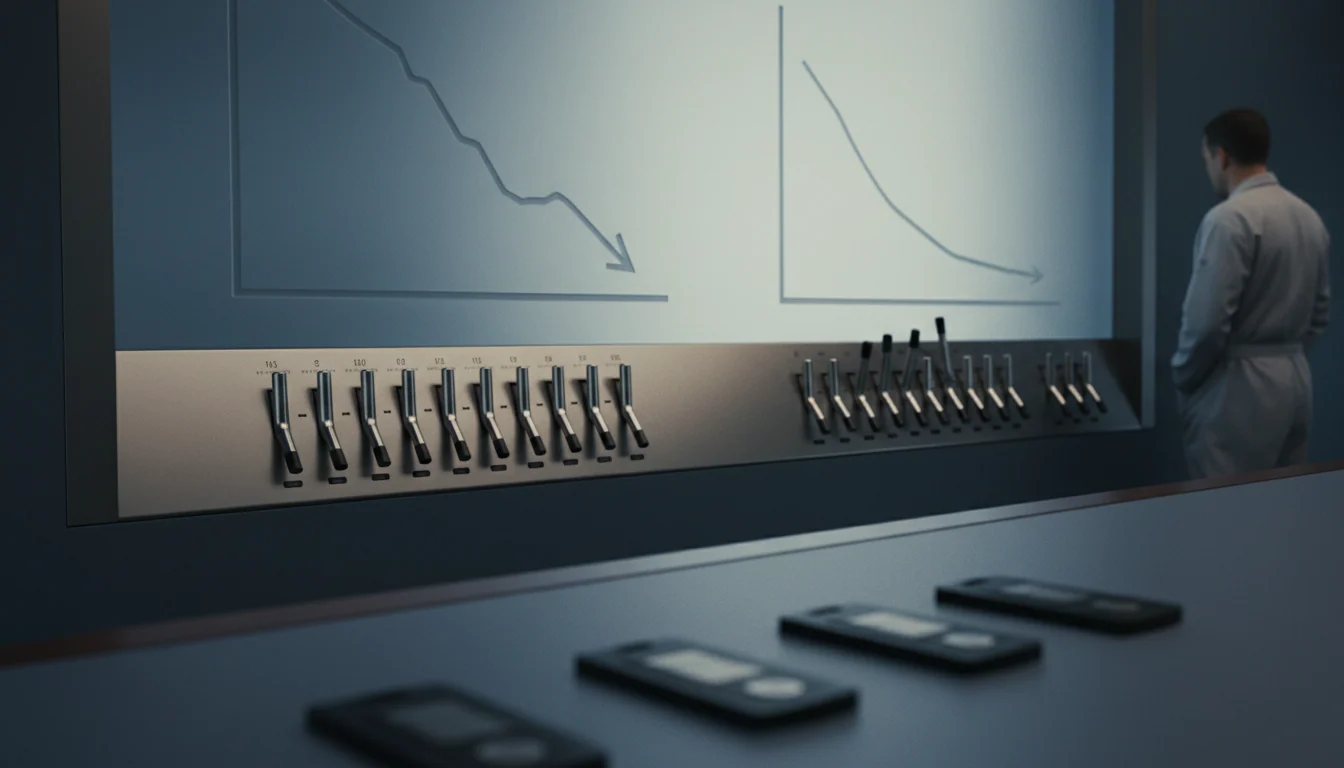
A study of 4 November 2026 shows that dynamic runtime authorisation curbs an AI agent immediately on a sudden decline, but leaves too much authority in place during gradual degradation. The lesson for decision-makers: build layered control that continuously recalibrates authorisation and enforces it outside the agent, not only in reaction to abrupt signals.
The finding comes from an empirical study that researchers published on 4 November 2026 on trust-responsive runtime authorisation for agentic AI. Runtime authorisation means that an agent's authority during the execution of a task moves with signals about trust, stability and risk, rather than being fixed in advance. The researchers compared such an adaptive policy with static, trust-only, risk-only and symmetric variants across a hundred matched synthetic traces.
The relevance for decision-makers who work with sensitive information: the idea that you make an agent safe by withdrawing its authority quickly only holds for sudden problems. During slow deterioration the same logic stays silent, while the agent continues to be allowed to carry out actions in the meantime. That is precisely the scenario in which an error builds up unnoticed.
What exactly did the research on trust-responsive runtime authorisation establish?
On abrupt degradation the adaptive policy withdrew authority immediately and recovered faster than the symmetric alternative. On gradual degradation that advantage largely disappeared: the agent retained too much authority during most of the deterioration. The authors themselves emphasise that the study works with synthetic signals, abstract authority levels and without a genuinely deployed agent.
Our analysis: in the synthetic scenarios tested, a policy that mainly reacts to sharp drops does not sufficiently weigh gradual drift. That is not a detail, because organisations also need to test how their authorisation policy deals with degradation that does not occur abruptly.
Why does curbing based on abrupt signals alone fail during gradual degradation?
Because a rule that reacts to jumps in a signal raises no alarm when there is a slow decline that stays below the threshold. The agent then continues to operate at an authority level that no longer matches its actual reliability. The problem does not lie in the agent itself, but in the control mechanism around it.
Two further studies provide the architectural context. Researchers describe in assurance-conditioned continuous authorisation an approach that derives authority from currently valid evidence and policy, and refuses outdated action authorisations as soon as their "authority period" no longer matches the current one. Their prototype works in a trading environment; the authors state explicitly that this does not demonstrate safety across multiple domains or protection against unobserved changes. A survey study on access control for AI agents adds that authorisation must remain bound to concrete actions and effect limits, because agents themselves choose their execution path, delegate work and operate under varying conditions.
What does a layered authorisation system with external enforcement look like?
The core idea from these sources together: separate what a model can do from what it may do, derive that right directly from current evidence, and enforce it outside the agent. A comparative study of agent-security incidents at OpenAI, Anthropic and Google argues that the model itself is not the full safety boundary and recommends executable scope contracts, least-capability access and independent containment. The researchers explicitly describe the framework as conceptual and not yet empirically validated.
A defensible system therefore combines, as we read these sources, the following layers:
- Limited reachable actions: set out per task which actions and effect limits are permitted, so that harmful actions become technically difficult.
- Continuous recalibration: reassess authority as soon as the model, harness, tools, environment or behaviour change, and not only on a sharp decline.
- Version control of authority: tie high-impact permissions to an authority period and refuse outdated authorisations at the protected effect limit.
- External enforcement and evidence: keep enforcement and recording outside the agent, so that the agent itself does not guard its own boundary.
- Safe end state and re-authorisation: ensure the agent can stop safely and only continues after new, valid evidence.
You address gradual degradation within this model by steering not only on jumps, but also on a trend over time. In our assessment that is the missing layer that the trigger study exposes.
What does this mean now for directors, lawyers and CISOs?
Our analysis: because the study shows that curbing fails under gradual deterioration, any organisation that relies on a single threshold rule runs the risk that an agent keeps doing too much for too long; therefore a CISO should, at the next architecture review, have it tested whether the authorisation policy also reacts to a trend and not only to an abrupt decline. Because authority, under the ACCA approach, should follow from current evidence, an agent with static permissions is by definition poorly grounded; therefore a director should now lay down that high-impact permissions get an expiry period and are revalidated at every change of context. Because the comparative incident study emphasises that the model is not the full safety boundary, a clause that addresses only the model supplier is not sufficient; therefore a lawyer should include in the contract that the scope, the independent containment and the separation of duties between agent, policy layer and human approver are demonstrably enforced and tested separately from the model. Because the three studies work with synthetic traces, a trading prototype and a conceptual framework, none of these mechanisms is proven for your own domain; therefore a responsible decision-maker should require an own test under gradual degradation before an agent may carry out sensitive actions independently, and document the result.
These lessons connect to known concerns about blind spots in monitoring agent tool calls and to liability when an agent carries out an unauthorised action. The practical claim remains modest: for professionals with sensitive information, reliable AI is reached sooner by making harmful actions difficult, bounded and stoppable than by relying on the prediction that a model will itself recognise every unsafe situation.
Sources and references
- Trust Responsive Runtime Authorization for Agentic AI with Empirical Characterization of Policy Behavior and Parameter Sensitivity
- Assurance-Conditioned Continuous Authorization for Autonomous AI Agents
- Rethinking Access Control for AI Agents: Recent Advances and Open Challenges
- From Reactive Containment to Proactive Assurance: Lessons from the 2026 OpenAI, Anthropic, and Google Agent Security Incidents
Sources: The article relies on three arXiv studies from November 2026 on runtime authorisation, continuous authorisation and access control for AI agents, and on a comparative arXiv study from October 2026 on agent security incidents.