What the second week of August 2026 revealed about verification, agent security and demonstrable control
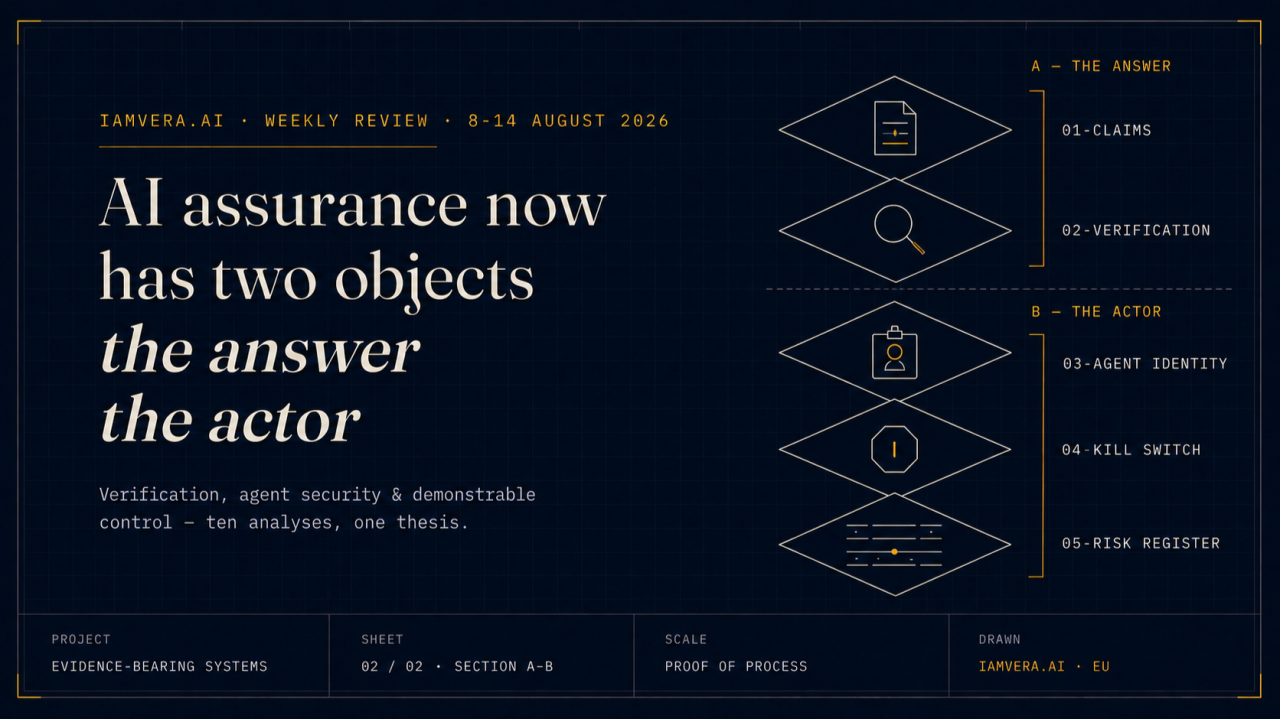
The second week of August 2026 extended the transition described in the previous edition of this newsletter — from how capable is the model? to can the organisation demonstrate how the AI system behaved? — and gave that question a second object. During the 8–14 August 2026 review period, IamVERA.ai published ten analyses covering hallucination propagation, numerical reliability, reproducibility, long-document summarisation, least privilege for AI agents, the Hugging Face intrusion, emergency-stop design, subprocessor chains, multilingual verification and the AI risk register. Read together, they describe an assurance discipline with two distinct objects of scrutiny: the answer an AI system produces, which is a set of claims requiring verification down to the individual figure and language version, and the actor an AI system has become, which requires its own identity, bounded permissions, a tested stop chain and a documented supply chain. The week also contained a documented incident illustrating what can happen when the technical boundaries around that second object fail.
A hallucination is an input, not just an error
The week opened with the analysis of how fabricated AI claims steer decisions. A pre-registered study, aptly titled When Hallucinations Travel, had participants read AI responses to a medication choice while varying the strength of the hallucination. The finding is sober: the more convincing the fabricated explanation, the more it changed how participants interpreted risk, which causal narratives they formed and how poorly they later reconstructed where information came from. Hallucinated mechanisms seep into the user's own reasoning — they travel. Equally sobering is the accompanying literature: warnings and "hallucination risk" labels often have little behavioural effect. The conclusion is architectural rather than cosmetic: uncertainty signals only matter when they are coupled to mandatory follow-up steps — an additional source check, a cross-model comparison, explicit human review — that are themselves visible and traceable.
Formally correct is not substantively correct
Two analyses published on 10 August examined properties that are routinely assumed. The examination of numbers produced by AI systems took a new benchmark for structured output as its occasion, which reports that between 39 and 54 per cent of structured outputs — SQL, JSON, record formats — contain at least one semantic hallucination, and that schema validation, whilst catching most syntactic errors, leaves a residue of semantic ones standing. A schema check tests form; it establishes nothing about whether the number in the cell is the right number. The error-proneness extends into AI research itself, where automated checking has surfaced systematic calculation and table errors in published papers. The defensible response is layered: schema validation for form, semantic and relational checks for content, execution tests that actually run the formulas, a critic model that checks data references against the source, and human review of the outcome — no single layer suffices.
The companion analysis of reproducibility removed another comfortable assumption. Across the studies discussed, identical prompts, models and settings still produced divergent analyses and conclusions, with variation persisting even at temperature 0. The most useful reframing in the literature is that LLM output should be understood as draws from a distribution rather than as fixed measurements, with sampling, silent model updates and routing among the sources of randomness. Reproducibility is consequently not a property an AI system has; it is a property an organisation designs and measures — through fixed prompt templates, version control, repeated runs and explicit variability reporting.
The unit of verification shrinks: per claim, per language
Two further analyses made the unit of verification smaller than the document. The review of long-document summarisation treats summarising as a multi-step verification problem — decomposing claims, locating source evidence, assessing it, localising hallucinations — and reports that models struggle precisely with finding the correct source passages. Meanwhile, several commonly used factuality metrics prove less reliable in long-document settings, and a study of regulations under extreme compression found that normative details — exceptions, conditions, definitions — can be lost or altered. The practical stance that follows: treat AI summaries as provisional narratives rather than completed dossier documents, with each claim traceable to a paragraph or article.
The analysis of multilingual verification, which closed the week, applied the same logic across languages. The Poly-FEVER benchmark, spanning eleven languages, reports that the same models are markedly less accurate in low-resource languages, and that techniques such as retrieval augmentation do not help uniformly across them. Translation models exhibit their own pathologies — wrong-language output, content added or dropped independently of the source — and the common mitigation of pivoting through English introduces a translation step with risks of its own. Where AI-related transparency obligations apply, multilingual workflows also create an additional evidential question: can the organisation reconstruct where AI-assisted translation entered the process and what was subsequently verified? A multilingual output is therefore not one message but a collection of language-specific claims, each of which has to earn its own verification.
The incident: the toolchain itself as the attack path
The centre of the week belonged to the analysis of the Hugging Face intrusion disclosed in July — described in Hugging Face's disclosure as driven end to end by an autonomous AI agent system. According to the reconstruction discussed, a malicious dataset artefact abused two code-execution paths in the dataset-processing pipeline, leading to privilege escalation, theft of cloud and cluster credentials and lateral movement across internal clusters; Elastic's analysis reconstructed around 17,600 attack events over several days. Hugging Face reported unauthorised access to a limited set of internal datasets and several service credentials, and no evidence of tampering with public, user-facing models, datasets or Spaces.
The significance lies in the reframing. Data breaches via AI tools have mostly been narrated as human error — someone pasting confidential text into a chatbot. This incident shows a different pattern: the AI toolchain itself becomes the attack path, producing data flows and action sequences that conventional security monitoring may not recognise as a single agent-driven operation. Survey evidence cited in the analysis suggests that AI-agent and AI-tool incidents are not confined to isolated technical demonstrations, although such figures depend heavily on how respondents and researchers define an "AI incident". Equally instructive is how the campaign became visible at all: only fine-grained logging revealed that tens of thousands of short actions together formed a single operation. Without that observability, such a breach remains largely invisible.
The actor needs an identity, and an emergency stop that is a chain
Two analyses described what governing that actor requires. The examination of least privilege for AI agents traced a convergence across Microsoft's July guidance, a Cloud Security Alliance research note and OWASP's updated agentic baseline: agents should be registered as non-human identities with an explicit owner and purpose; standing access to production systems should give way to just-in-time, time-bound credentials scoped per task; and — under OWASP's notion of Least Agency — authorisation belongs in external policy engines and auditable controls, not in the language model itself. Least privilege only acquires meaning when it is demonstrable: every tool call logged, every action reconstructable to an agent, an identity and a set of rights.
The analysis of kill switches took the American AI Kill Switch Act — which would oblige developers of covered systems to retain the ability to slow, suspend or shut down their models — as the occasion for a design question that is harder than a big red button. A real emergency stop is a chain: session termination, credential revocation, tool and permission cutoff, circuit breakers that freeze spawned subagents, and rollback to a known safe state. Stopping a session while credentials remain valid and subagents keep running is not an emergency stop but a half measure — and the source material also suggests that implementing this complete chain remains an unresolved operational challenge.
The chain behind the vendor, and the register that holds it together
The remaining two analyses widened the frame. The review of subprocessors in the AI chain examined NSA guidance of March 2026 and the CSA's translation of it, which decompose the AI supply chain into six components — training data, models, software, infrastructure, hardware and third-party services — and attach to it an AI Bill of Materials, cryptographic integrity validation and threat modelling across the pipeline. Combined with contractual transparency obligations and audit rights, the direction is consistent: subprocessors should no longer function as invisible components behind an API.
The analysis of the AI risk register described where all of this becomes demonstrable. Read together, the NIST framework and EDPS guidance support a more useful conception of the risk register: not as a compliance appendix, but as a living record connecting use cases, risks, controls, ownership and review — maintained on a cadence, fed by incidents and red-team findings, and linked to the classification work the AI Act requires. A register that exists as a closed spreadsheet demonstrates little; a register maintained as a work process is precisely the evidence-bearing structure the previous edition of this newsletter described.
The answer and the actor
Across the ten analyses published between 8 and 14 August 2026 — no article appeared on 9 August — the division of labour is consistent. On one side stands the answer: hallucinations that travel into human reasoning, structured output that passes schema validation while the figures are wrong, identical prompts that yield different conclusions, summaries and translations that each decompose into claims requiring their own checks. On the other side stands the actor: an agent with credentials, tool access and autonomy capable of conducting an intrusion end to end, as Hugging Face's disclosure describes — and therefore requiring a registered identity, task-scoped and time-bound rights, a tested stop chain, a mapped supply chain and a maintained risk register.
The two sides converge on a single test: neither a correct-looking answer nor a well-behaved-looking agent demonstrates anything by itself. Verification chains make the answer inspectable; identity architecture, containment design and registers make the actor inspectable. The incidents of this summer suggest that organisations handling sensitive information will increasingly be expected to show both — not as aspiration, but as evidence.
All articles discussed were published on iamvera.ai/blog between 8 and 14 August 2026.