What the third week of August 2026 revealed about evidence, oversight thresholds and the boundaries of the AI actor
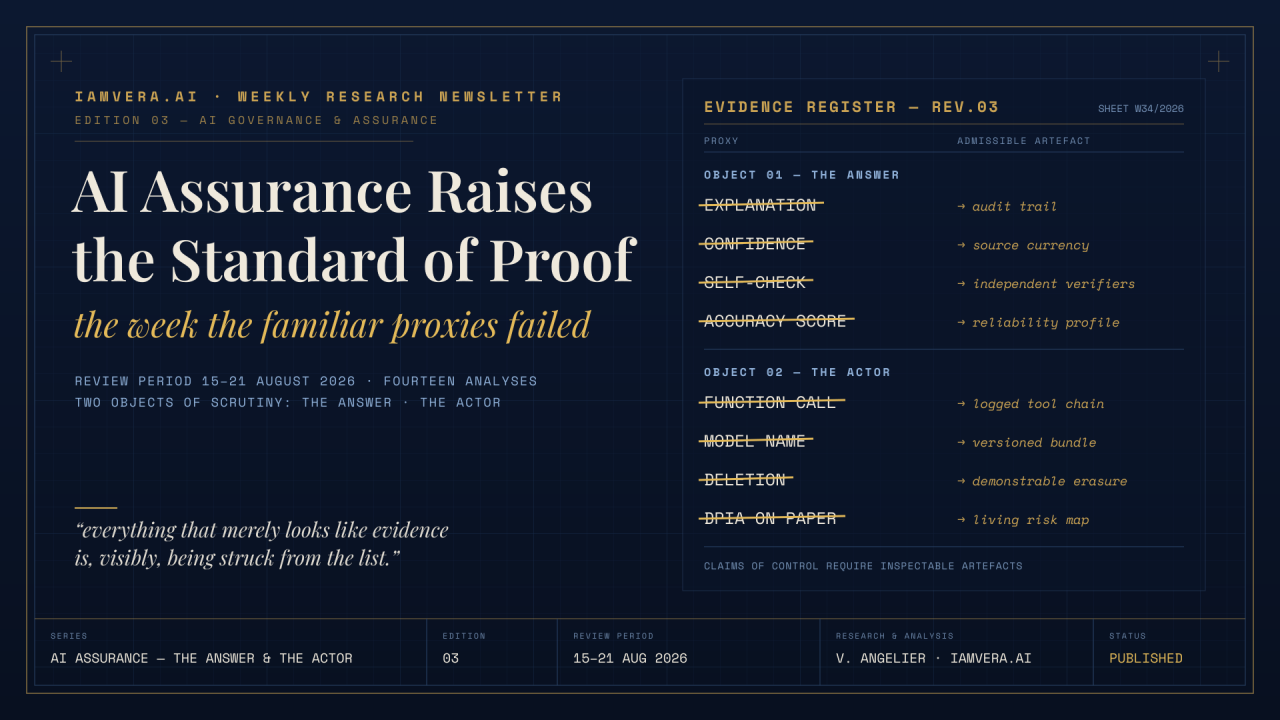
Abstract — The third week of August 2026 redefined what counts as evidence in AI assurance. Across fourteen analyses published between 16 and 21 August, one familiar proxy after another was disqualified: an explanation is not an audit trail, an accuracy score is not reliability, a well-formed function call is not a controlled action, a model name is not a version, deletion in an interface is not erasure, and a DPIA on paper is not control. What replaces them, on the answer's side, are designed verification chains — claim-level checks against demonstrably independent models, source and currency tracking, tamper-evident decision records. On the actor's side: registered tool permissions, explicit memory and retention policy, versioned behaviour bundles and documented decision thresholds. Across the regulatory and governance material reviewed this week, the direction is increasingly consistent: claims of control carry weight when they are supported by inspectable, independently testable artefacts.
The previous edition of this newsletter described AI assurance as having two objects of scrutiny: the answer an AI system produces and the actor an AI system has become. The third week of August 2026 addressed a question that sits beneath both: what actually counts as evidence about either one? During the 15–21 August 2026 review period, IamVERA.ai published fourteen analyses between 16 and 21 August — no article appeared on 15 August — covering tool use and function calling, explainability and auditability, source currency, single-model verification, evaluation benchmarks, RAG poisoning, prompt injection, AI memory, change management, decision thresholds, board accountability, GDPR obligations for scraping and anonymisation, demonstrable control of personal data, and the DPIA. Read together, they form a catalogue of disqualifications. One after another, artefacts that organisations habitually treat as evidence turn out not to qualify: an explanation is not an audit trail, an accuracy score is not reliability, a well-formed function call is not a controlled action, a model name is not a version, a refusal is not non-retention, deletion in an interface is not erasure, and a DPIA on paper is not control. The week's work was to say, with unusual precision, what does qualify instead.
An explanation is not an audit trail
The analysis of explainability opened the sharpest distinction of the week. A synthesis of research from, among others, Apple, the Santa Fe Institute and Google DeepMind warns that a model's chain-of-thought narrative does not necessarily reflect its actual decision process: a model can reach an answer through shortcuts and generate a plausible explanation alongside it that describes nothing causally. Whoever files that narrative as evidence has filed a story. Practical comparisons of the AI Act's articles 12, 19 and 26, ISO/IEC 42001 and NIST guidance translate that distinction into a stricter technical standard: retained decision artefacts, integrity controls that make later modification evident, and sufficiently reliable timestamps — records that allow reconstruction without relying on the model's own narrative. Explainability and auditability serve different purposes; auditability is the layer that produces retained artefacts from which a regulator or auditor can reconstruct what happened. The distinction matters for every organisation that currently answers audit questions with a reasoning transcript.
A confident answer is not a current answer
The companion analysis on source currency removed a quieter assumption: a factually coherent answer can still be unsuitable for use when its underlying source has been superseded. Outdated, inaccessible or incompletely recorded data feed directly into confidently phrased answers — and the model typically does not flag its own obsolescence. Clinical and research frameworks discussed in the analysis converge on the same design response: every output claim traceable to an authoritative source with a reference, a visible information date, AI output treated as a provisional draft, and periodic audits of the underlying data. The reframing is the useful part: an AI answer is a time-bound knowledge claim, valid only insofar as the source it rests on still corresponds to reality. Currency is not a quality detail; it is a verification dimension of its own.
A model checking itself is not verification
Two further analyses dismantled comfortable ideas about checking. The examination of single-model verification starts from peer-reviewed work on fragment-level verification and its central observation: a model is not a reliable assessor of its own output. Verification only emerges when generation and checking are separated, and checking is placed with models that demonstrably behave differently. That last clause carries weight. A study of model independence shows that large language models are strongly correlated in their behaviour — trained on comparable data, they share blind spots, so a naive majority vote can confirm shared errors rather than correct them. Only when ensembles are reweighted for measured independence does verification improve measurably. Survey data underline how unstable single-model figures are in the first place, with reported hallucination rates for the same model varying sharply by task and benchmark design. The conclusion is architectural: verification is a designed chain with deliberately diverse checkers, working at claim level, with human review directed at the points where models disagree.
An accuracy score is not reliability
The week closed by applying the same scepticism to evaluation itself. An ICML paper decouples reliability from accuracy and decomposes it into consistency, robustness, predictability and safety — a profile rather than a leaderboard number, modelled explicitly on safety-critical engineering. Its empirical finding is the sobering one: across fifteen frontier models, capability improved while reliability did not improve proportionally. Benchmark results discussed alongside it point the same way — in one production-like safety benchmark, none of thirteen widely used agents reached forty per cent task completion without violating safety rules, and a survey of 210 safety benchmarks concludes that many are weakly linked to real risks. An organisation-level safety index, grading nine large AI companies between C+ and F, adds the final layer: technical scores and organisational governance are different things, and both must be demonstrable. For business-critical deployment, evaluation starts to look like a crash test, not an IQ test.
What the answer relies on becomes an attack surface
The analysis of RAG poisoning connected the answer's evidence problem to security. A study of medical multimodal retrieval-augmented generation shows a query-agnostic attack: inject misinformation into the knowledge base, and the system retrieves clinically plausible but false passages without the prompt ever being touched. Related work shows that vulnerability depends on architectural choices — retrieval depth, retriever type, corpus composition — and that manipulation can hide in metadata while the visible content remains correct. A knowledge base that passes inspection can still be compromised. The consequence for high-trust deployment is that provenance moves to the centre: the question is no longer only what the model says, but where its context came from and whether that source layer is itself monitored, segmented and verifiable.
A correct function call is not a controlled action
The week opened, on Sunday, with the layer through which the actor touches the world: tool use. The occasion was BFCL V4, the latest version of the Berkeley Function Calling Leaderboard, which no longer measures only whether a model calls the right function with the right parameters but tests agentic behaviour across multiple turns, chained tools, memory and — tellingly — the ability to call no tool at all. The analyses discussed report that frontier models score very highly on simple single calls while performance drops on complex multi-turn scenarios: producing correctly structured JSON is not the same as behaving reliably as an agent. The security side sharpens the point. A jailbreak study, as summarised in the coverage discussed, describes how function-calling models can be driven to unauthorised tool calls through simulated moderation — the moderation layer itself deceived — even with classic prompt-injection mitigations in place. Two proxies fall at once: syntactic correctness is not reliability, and moderation inside the model is not independent control. What replaces them is a verifiable chain: which tools exist, which agent identities may call which functions, every call logged, and anomalous calls checked outside the model.
The actor retains what it refused, and remembers what you deleted
Two analyses examined layers that conventional controls miss. The analysis of prompt injection as an architecture flaw discusses July 2026 research from the University of Washington, as summarised in the coverage discussed, finding that agents refused harmful instructions yet stored them in persistent memory, after which behaviour in later sessions was influenced regardless — a refusal, it turns out, is not non-retention. The same week's memory analysis documented the complementary risk: a July demonstration in which an assistant's default memory, combined with web tools, was abused to exfiltrate personal data inferred from chats, and a joint note from the French CNIL naming persistent memory as the first of three GDPR risks for agentic AI, qualifying long-term interaction profiles as profiling with the corresponding requirements around consent, retention and erasure. Two practical lessons recur across the governance material: memory enlarges the surface for compulsory disclosure demands, and deleting in the interface is not the same as erasing in the system. Prompt injection meanwhile has escalated beyond text — a vulnerability in Microsoft's Semantic Kernel framework showed a single injection reaching remote code execution at host level, and NIST's updated adversarial-ML taxonomy now names indirect prompt injection, memory poisoning and tool misuse as attack classes requiring architectural controls, not better filters.
A model name is not a version
The change-management analysis supplied the actor's quietest failure mode. Providers make changes under an unchanged model name — context limits, routing, review prompts, sometimes partially rolled back — so that several behaviour versions exist under one alias, without an incident report. The behaviour of a production system resides not in the model but in the whole bundle: model, prompts, tool schemas, retrieval, policies, runtime. The defensible response, aligned with the NIST AI RMF's governance functions, is to treat every change as a versioned release of that complete bundle: immutable release identifiers, canary routes, hard rollback triggers, and release evidence capturing behaviour before and after. Without that, an organisation cannot answer the question that matters after a contested decision: which version was active, on which data, at which moment.
The threshold becomes a documented design variable
Where exactly the actor must stop and a human must enter is ceasing to be an implicit UX choice. China's Implementation Opinions on intelligent agents, issued in May 2026 by three Chinese authorities as the first national policy framework dedicated specifically to AI agents, distinguish three bands of decision authority — actions reserved to the user, actions requiring the user's authorisation, and actions an agent may take autonomously — and expect organisations to document their agents' autonomy and boundaries before deployment. The European route arrives at the same point differently: the AI Act's oversight obligation, confirmed in the consolidated Digital Omnibus text, requires oversight commensurate with risk and autonomy, and practitioner frameworks translate this into explicit decision bands — allow, warn, require approval, block — driven by consequence, reversibility, data sensitivity and model confidence. The convergent requirement is not any particular threshold but its documentation: boundaries set in advance, enforced in the workflow, and checkable afterwards.
The organisation must be identifiable, and its control demonstrable
The regulatory analyses of the week drew the frame around all of this. The EDPB and EDPS, in their joint opinion on the Digital Omnibus discussed in the analysis of board accountability, support simplification but warn that removing registration obligations would substantially undermine accountability — and that letting providers self-classify systems as not high-risk creates an incentive to wrongly claim exemptions. The adopted guidelines on web scraping and the new anonymisation guidelines close familiar escape routes with a three-step test — no record isolation, no linkage, no inference — under which models and synthetic data often remain within the GDPR, while transparency obligations applying from 2 August 2026 mean direct AI interaction may not remain undisclosed. Singapore's PDPA guidance, requiring AI-specific notice language where personal data feeds generative-AI development, extends the same logic beyond Europe. And the DPIA analysis described where these strands must land: not in a one-off document but a living risk map covering the entire lifecycle — for agents extending to tool permissions, memory functions and autonomous action paths, in some cases paired with a fundamental-rights assessment. The recurring word across all four analyses is the same: demonstrable. Across the regulatory material reviewed, statements of intent are increasingly insufficient on their own; organisations are expected to support claims of control with evidence of how their AI systems are governed in practice.
What counts as evidence
Across the fourteen analyses published between 16 and 21 August 2026, the pattern is consistent. On the answer's side, the proxies fail one by one: the explanation, the confidence, the benchmark score, the self-check, the clean-looking knowledge base. What replaces them are verification chains — claim-level checks against diverse models, source and currency tracking, tamper-evident decision records. On the actor's side, the familiar reassurances fail equally: the well-formed function call, the in-model moderation, the refusal, the deletion, the model name, the informal handover point. What replaces them are explicit boundaries — registered tool permissions, memory and retention policy, versioned behaviour bundles, documented decision thresholds, and the registers and assessments that make an organisation's arrangements identifiable to a regulator.
The previous edition argued that neither a correct-looking answer nor a well-behaved-looking agent demonstrates anything by itself. This week's material sharpens that claim: the evidential burden is becoming more concrete. Assertions of control increasingly need to be supported by records that can be inspected, reconstructed and challenged independently — and everything that merely looks like evidence is, visibly, being struck from the list.
All fourteen articles discussed were published on iamvera.ai/blog between 16 and 21 August 2026, within the 15–21 August review period.