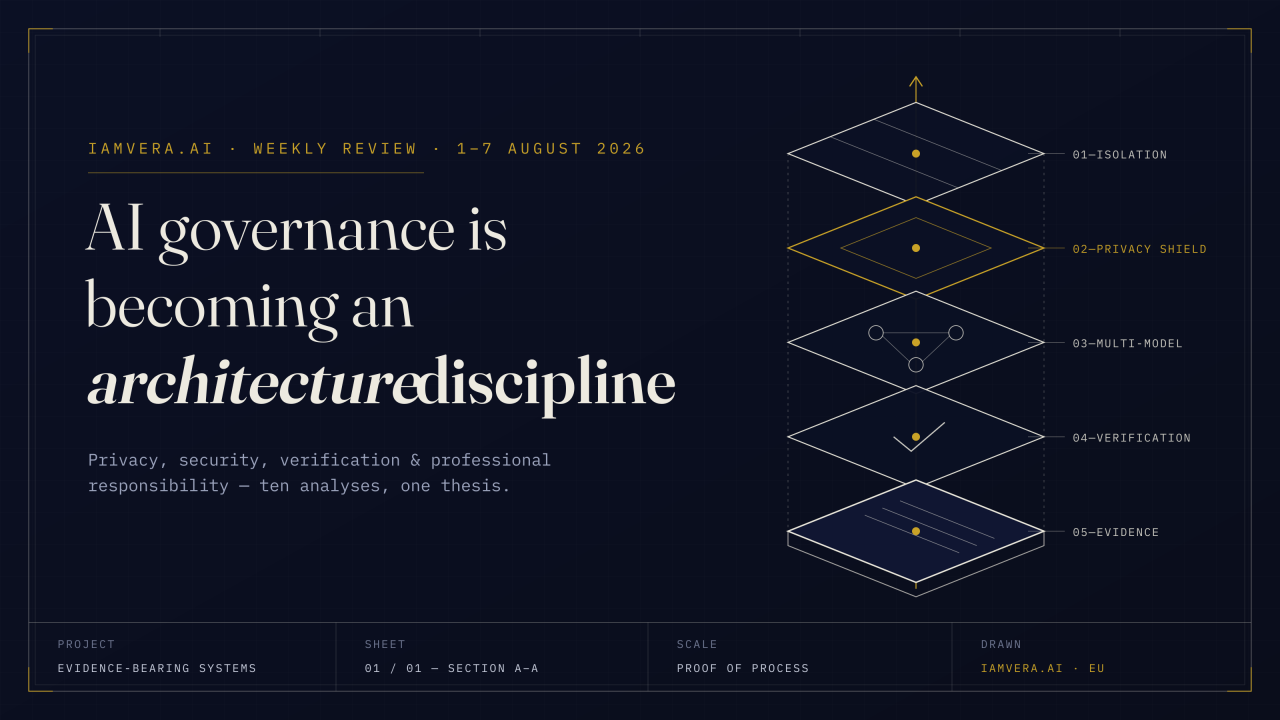
What the first week of August 2026 revealed about privacy, security, verification and professional responsibility The first week of August 2026 produced a remarkably consistent signal across developments in AI regulation, cybersecurity, privacy and professional practice. During the 1–7 August 2026 review period, IamVERA.ai published ten analyses covering session isolation, the EU AI Act, shadow AI, procurement, secrets management, model memory, data retention, confidence calibration, professional confidentiality and the increasingly blurred distinction between local and cloud AI. These subjects appear separate; they are not. Across all ten, the central question is shifting from how capable is the model? to can the organisation demonstrate how the AI system behaved?
That distinction matters because model quality alone cannot establish whether confidential information was isolated correctly, whether credentials were exposed, whether personal data should have been deleted, whether records were retained for an appropriate period, or whether a decision-maker was presented with meaningful uncertainty rather than artificial confidence. Those are properties of the surrounding architecture. The emerging discipline of AI governance and assurance is therefore increasingly concerned with evidence-bearing systems: architectures in which data flows, permissions, models, verification steps and consequential decisions can later be inspected and reconstructed. This does not imply that every organisation requires the same technical stack. It does mean that claims of responsible AI become credible only where they can be supported by inspectable controls, operational records and proportionate evidence.
AI security starts outside the model
The week opened with an instructive example of why AI session isolation and cross-user data leakage cannot be reduced to model alignment or prompt security. A vulnerability affecting Writer's agent-preview functionality reportedly made cross-tenant account takeover possible, exposing private chats, documents, agents, connectors and LLM credentials. What made the case particularly instructive was what did not happen: the language model was neither jailbroken nor induced to produce a malicious answer. The security boundary surrounding it had simply failed. As AI systems acquire persistent memory, retrieval infrastructure, connectors, sandboxes and autonomous tool access, information can move between components through caches, vector stores, logs or shared state even when every individual model interaction appears legitimate. Session separation can therefore no longer be assumed because an interface presents two conversations as distinct; isolation must exist across memory, credentials, execution environments and lifecycle management — an architectural rather than model-level property, and one that OWASP's guidance now treats as a required control rather than optional hardening.
The same reasoning recurred in the analysis of secrets management for AI workflows. The June 2026 LiteLLM vulnerabilities — including a pre-authentication SQL injection through which all stored provider API keys could be read remotely — illustrate what happens when model API keys, cloud credentials and access tokens are treated as configuration details rather than privileged machine identities. Persistent secrets inside gateways, configuration files, prompts, retrieval stores or agent memory create systemic compromise paths: a single compromised component can expose access to every model and downstream system its credentials represent. A more defensible architecture relies on narrowly scoped, short-lived credentials injected only when a specific operation requires them, with prompts, model context, retrieval indices and general-purpose logs functioning as explicit no-secret zones. Even a dedicated vault, however, establishes little on its own; as one documented attack chain through AWS Secrets Manager showed, the meaningful control is the relationship between identity, permission, purpose, time and observable use.
The EU AI Act is becoming an implementation problem
The regulatory dimension became especially visible on 2 August. The analysis of EU AI Act classification, transparency and logging requirements examined the consequences of the Digital Omnibus, under which the application of the high-risk obligations has been deferred to December 2027 and August 2028, alongside obligations that remain immediately applicable. The transparency duties of Article 50 — machine-readable marking of AI-generated content and duties to inform affected persons — took effect on 2 August 2026 as scheduled, and the Commission's draft classification guidelines already require organisations to inventory which systems they operate and under which annex those systems may fall.
The significance is not simply that deadlines exist or move. The more important development is that AI regulation increasingly translates abstract principle into questions of system implementation. A policy stating that an organisation uses AI responsibly is fundamentally different from an architecture capable of demonstrating which system was used, which model configuration applied, which information entered the workflow, what was produced and where human oversight occurred. That movement from principle towards demonstrability is the strongest theme connecting the entire week.
Shadow AI turns visibility into a governance requirement
The analysis of shadow AI as a governance and data-visibility problem approached the same issue from inside the organisation. Recent workforce and security research — including survey findings that two-thirds of office professionals have used unauthorised AI tools at work, and Verizon's 2026 Data Breach Investigations Report linking unapproved AI use to actual breaches — shows that employees adopt AI because it delivers immediate practical value. Where approved systems offer no comparable utility, prohibition merely displaces usage towards personal accounts and private devices, where visibility disappears entirely.
This exposes a structural weakness in policy-led governance. A rule stating that employees must not upload confidential information does not demonstrate that confidential information has not been uploaded; an approved-tools register does not demonstrate that only approved tools are used. The operational requirement is therefore observability — proportionate insight into which AI services are in use, which categories of information may reach them, and what evidence remains afterwards — rather than indiscriminate surveillance. The conclusion is difficult to avoid: an organisation cannot meaningfully govern AI use that it cannot see.
Procurement is shifting from promises to evidence
The same movement now appears before an AI system is even purchased. The week's review of AI procurement requirements and verifiable selection criteria examined how the US Department of Energy's Acquisition Letter, the Department of the Interior's procurement memorandum, the proposed GSA safeguarding clause and California's executive order collectively bind AI suppliers to impact assessment, bias testing, data provenance, security architecture, incident reporting and auditing — as conditions of eligibility, payment and termination rather than aspirational best practice.
Although the immediate examples concern US public procurement, the underlying shift is broader. A provider may contractually promise that customer data will not be reused for training; that assurance becomes materially stronger when the surrounding architecture makes the relevant data flow inspectable. A provider may state that activity is logged; the existence of logs matters little if nobody can establish what was recorded, under which identity, or with which model configuration active. AI procurement consequently begins to overlap with continuous assurance: the model is no longer the entire product, because part of the product is its ability to produce evidence about its own operation.
Privacy now extends into model memory — and retention pulls the other way
Two articles examined information governance from opposite directions. The examination of the right to erasure and personal data in AI model memory analysed the EDPB's Guidelines 03/2026 on web scraping for generative AI, which confirm that scraped training data fall within the GDPR and acknowledge that, once trained, a model cannot easily be cleansed of personal data. Current machine-unlearning techniques remain approximate — audit tests for "forgetting" have largely been validated on synthetic data and smaller models — while full retraining remains the most complete remedy described. The governance problem therefore extends beyond stored records towards data provenance and model influence: without knowing where information originated and which models and indices absorbed it, a deletion request becomes an exercise in assumption.
The analysis of retention periods for AI prompts, outputs and audit logs examined the countervailing obligation. For high-risk AI systems, Article 12 requires the technical capability to generate logs automatically, whilst Articles 19 and 26(6) require providers and deployers, respectively, to retain logs under their control for an appropriate period of at least six months, subject to applicable Union or national law. The GDPR's storage-limitation principle meanwhile functions as a ceiling for any log containing personal data, and sectoral regimes in finance push horizons to five or seven years. The solution can be neither "keep everything" nor "delete everything quickly": mature AI data-retention policy requires decisions at data-category and workflow level. The precise architectural objective is to retain enough evidence to establish accountability whilst avoiding unnecessary retention of the sensitive content that created the risk in the first place — which is why privacy-preserving preprocessing and data minimisation reduce the complexity of the entire downstream assurance problem, not merely the initial processing.
Confidence is not verification
Technical governance also concerns what an AI system communicates to the person using it. The analysis of AI confidence scores and uncertainty calibration examined a persistent misconception: that the confidence a language model expresses can be read as a probability that its answer is true. The 2026 calibration literature indicates otherwise. One ACL study demonstrates that the calibration error of large language models in interactive settings has a non-vanishing lower bound absent active calibration; a benchmark on verifiable facts identifies the category of confident errors — answers delivered with sources and an assured tone that are substantively wrong; and empirical work shows that verbalised confidence correlates poorly with correctness, whilst answer-frequency across repeated sampling calibrates considerably better.
The implication for interface design is direct. Displaying "92% confidence" appears quantitative and objective, yet unless that figure has a measured relationship with empirical correctness for the relevant model and task, it risks becoming persuasive decoration that shapes when users investigate, when they seek a second source, and when they accept a conclusion unexamined. A more defensible approach treats uncertainty as a risk signal that triggers escalation — disagreement between independent models, missing provenance, unstable outputs — rather than as reassurance. Multi-model comparison does not manufacture certainty, since models can share weaknesses; its value lies in exposing disagreement rather than concealing it behind the fluency of a single answer.
Professional secrecy and the dissolving local–cloud binary
The implications become tangible in professional practice. The examination of safe AI use for lawyers and notaries considered the CCBE's technical guide of March 2026 alongside Singapore's ministerial guidance and Law Society advisory. Their convergent position is that professional secrecy under conditions of AI use is secured not by careful prompt phrasing but by assessed data flows, contractual scrutiny of providers, anonymisation before submission, substantive human review before any output enters a case file, and records of who verified what. Professional responsibility is not removed by AI; it acquires an additional technical layer through which it must be exercised — a conclusion that extends readily to healthcare, compliance, journalism and public administration.
Finally, the analysis of local AI versus cloud AI privacy architecture argued that the familiar equation — local equals private, cloud equals risky — is increasingly inadequate. Apple's WWDC 2026 announcements position a hybrid stack of on-device inference and Private Cloud Compute explicitly as a verifiable privacy architecture, whilst recent academic work contends that on-device AI is not a sufficient privacy boundary in itself: operating-system permissions, telemetry, extensions and local logs determine what leaves a device regardless of where inference runs. The useful question is not where the model runs, but what data reaches which component, for what purpose, under whose authority, for how long — and what evidence demonstrates that this is what actually happened. That favours task-specific hybrid architectures over ideological choices, with the assurance challenge lying in defining, enforcing and documenting the boundary between them.
From responsible-AI principles to evidence-bearing systems
Across the ten analyses published between 1 and 6 August 2026 — no article appeared on 7 August — the same pattern recurs. Cross-session data leakage shows that confidentiality depends on enforceable system boundaries, and secrets management recasts credentials as controlled machine identities. EU AI Act implementation turns governance principle into classification, transparency and logging, whilst procurement criteria increasingly demand evidence rather than assurances. The right to erasure makes provenance relevant even after training; retention requirements oblige organisations to preserve evidence without hoarding sensitive content. Shadow AI governance demonstrates that policy without visibility provides weak control, and confidence calibration shows why apparent certainty cannot substitute for verification. Guidance on AI use by lawyers and notaries binds technical controls to professional responsibility, and the debate over local versus cloud AI privacy ultimately resolves into a question of controllable, inspectable data flows.
Taken together, the week's contributions articulate a coherent transition: AI systems handling sensitive information must be designed for isolation, secrets hygiene, verifiable data flows, explicit retention and erasure regimes, calibrated uncertainty handling, and continuous demonstrability of compliance. Regulatory postponements do not defer these requirements; professional standards and procurement criteria embed them as selection conditions; and the documented vulnerabilities confirm that architectural shortcuts produce systemic risk. Traditional software assurance long ago recognised that security cannot be inferred from an application that merely appears to function correctly, and AI governance is arriving at the same realisation: an apparently correct answer says little about whether sources were reliable, confidential information was exposed, or an agent held excessive privilege. The output is only one artefact in a larger evidence chain.
The objective, then, is not to construct systems that claim to be responsible, but systems in which responsible operation leaves evidence. There may never be a language model that can simply be declared trustworthy in every context. A system, however, can be designed so that trust is not the only thing we have to rely on.
All articles discussed were published on iamvera.ai/blog between 1 and 7 August 2026.