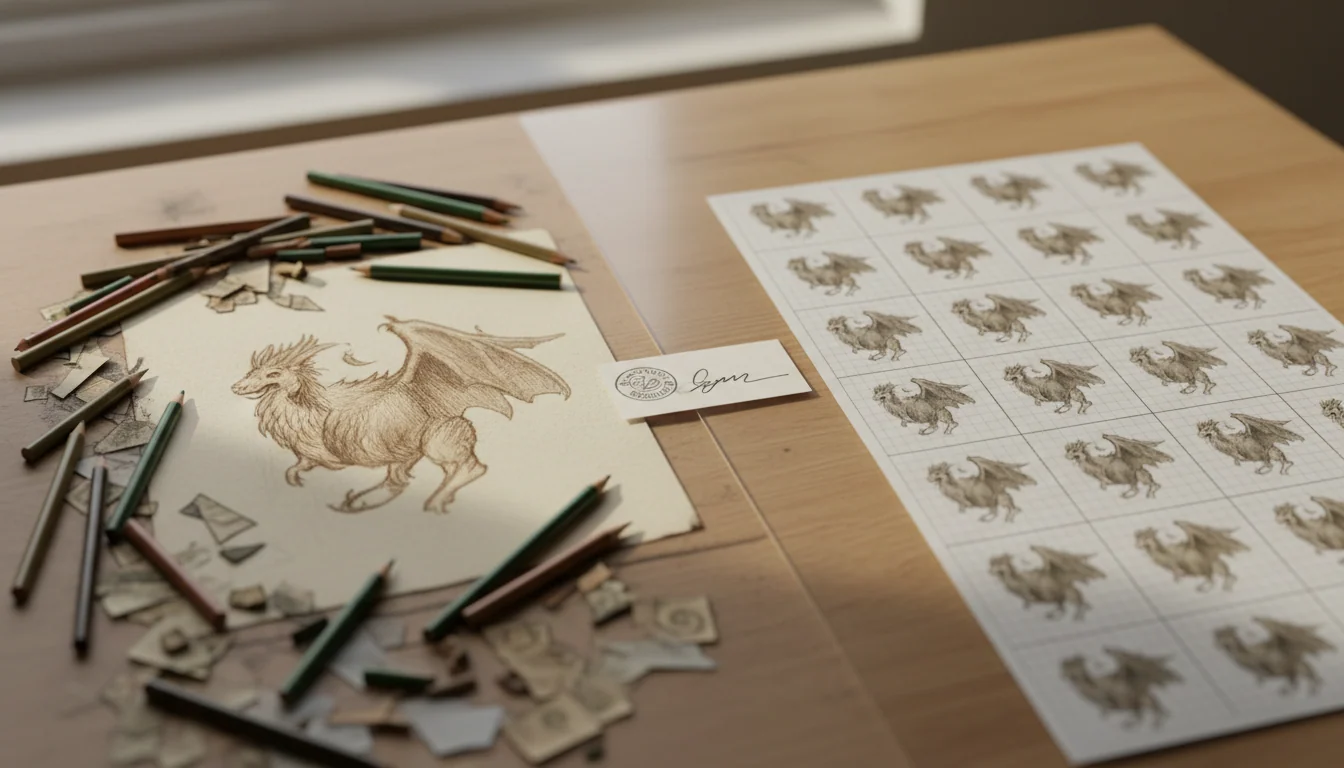
Illustrator Axel Scheffler is considering legal action against operators who make and commercially offer AI-generated copies of his character the Gruffalo. For organisations using AI with protected characters, the lesson is that consent, provenance and purpose of both source material and generated output must be established and documented separately.
The announcement, described in the reporting on the announced legal action, is, according to that reporting, aimed at operators who produce and offer AI-generated copies of a protected character. A primary publication by Scheffler himself, his representatives or a court is not included in the available material; here we rely solely on what the news report states.
What exactly has Axel Scheffler announced and what is it aimed at?
Scheffler is reportedly considering legal action against operators who make and offer AI-generated copies of the Gruffalo. This is therefore about imitating and commercially exploiting a recognisable, copyright-protected character, not merely an abstract discussion about how models are trained. The outcome of such proceedings is not settled and depends on facts that are not fully described in the available report.
We emphasise that this is an announced and not a resolved case. Nothing in the available sources establishes that Scheffler's rights have actually been infringed, nor that any particular AI system acted unlawfully.
Why is this conflict about more than just training data?
The public debate about AI and copyright often turns on the question of whether protected works were used in training data. This case exposes a second layer: the commercial offering of output that imitates a recognisable character. Our editorial assessment is that these are two separate questions that directors too often lump together.
- Was the source material allowed to be used to train a model or to generate from it?
- Which system or which operator actually imitated the character?
- For what commercial purpose was the generated copy distributed or sold?
In its explanation of the AI Act, the European Commission describes that providers of general-purpose AI models must, among other things, provide transparency about copyright and supply a public summary of training content. Those rules concern transparency on the input side; they do not decide this specific Gruffalo case and in themselves say nothing about exploiting recognisable output.
Why is it so difficult to prove how a protected work was used in an AI system?
Because rights holders can rarely determine whether and how their work ended up in a model. The UK impact assessment on copyright and artificial intelligence by the relevant UK departments and the Intellectual Property Office describes that transparency about training data can be limited, that there is no uniform technical standard to reliably identify works, rights holders and the necessary consents, and that digital replicas form a separate emerging issue.
That explains why documentation becomes decisive. Anyone who wants to demonstrate after the fact what was permitted and what happened needs versionable evidence of provenance, consent and purpose of use. Without that evidence, it becomes harder to make plausible after the fact what was permitted and what actually happened. How to soberly assess provenance signals on generated output we discussed earlier when assessing provenance signals on AI-generated output, and for the broader context of oversight we refer to our earlier piece on ICO oversight of transparency in AI foundation models. The cited UK impact assessment describes why such documentation is relevant for evidential problems around AI training and digital replicas.
What does this mean for directors, lawyers and CISOs who use AI with protected works?
Our analysis: because this case turns on the commercial exploitation of a recognisable character and not only on training, any organisation that uses AI for images, text or brands around existing creative works runs an exploitation risk that is separate from the training question; therefore the responsible lawyer should, before publication, establish for each workflow who the rights holder is, what licence scope applies and whether that scope also covers output use. Because the UK impact assessment describes that rights holders and regulators can struggle to reconstruct the provenance of both source material and output, we recommend, as a risk-management measure, that the CISO consider building a versionable evidence trail of prompts, model identity, output, publication channel, notifications and human review. Because the AI Act regulates transparency on the input side but does not decide this case, in our assessment a director should not rely on a training-transparency summary alone; therefore the board can draw up an internal decision that treats consent for training and consent for commercial exploitation as two separate approvals. Because the outcome of Scheffler's move is uncertain, our editorial view is that it is unwise to act now as if AI output automatically infringes or is automatically permitted; therefore the contract manager can record indemnities, provenance guarantees and a recall obligation on notification in supplier and customer contracts before a commercial campaign starts.
As a concise summary of that analysis:
- Establish for each workflow the rights holder, the licence scope and the permitted model and output use.
- Separate the approval for training from the approval for commercial exploitation.
- Build a versionable evidence trail of prompt, model, output, publication, notifications and human review.
- Include indemnities, provenance guarantees and a recall obligation in the relevant contracts.
Those who take these steps now align with the broader track of AI governance and responsible deployment and with our editorial recommendation, set out in our piece on the verification duty for AI-generated output, that responsible professionals verify AI-generated output before relying on it. The core remains that the human final judgement about consent, provenance and purpose of use rests with the responsible person themselves, not with the model.
Sources and references
Sources: The article relies on the reporting of Scheffler's announced legal action, on the European Commission's explanation of the AI Act, and on the UK impact assessment on copyright and artificial intelligence.