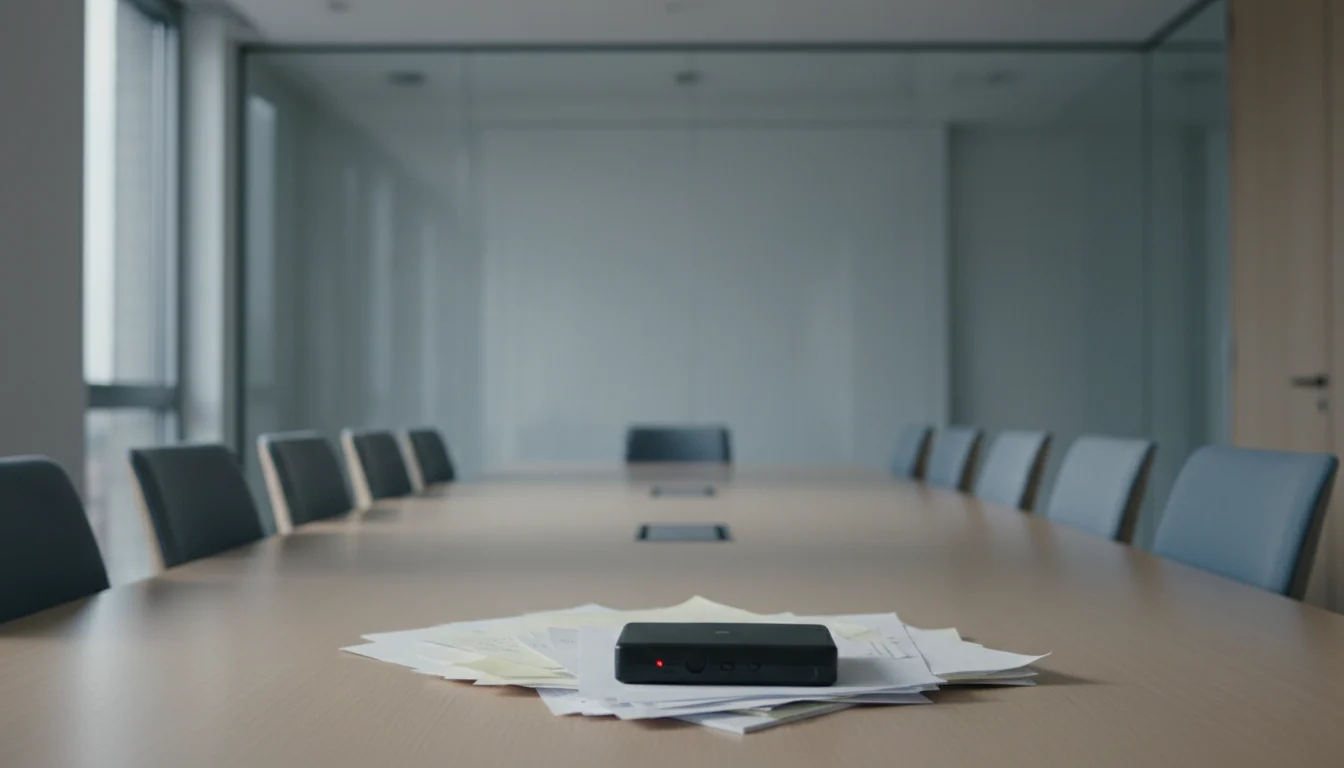
US prosecutors accuse former OpenAI engineer Abdulrahman Alfozan of placing a hidden, encrypted recorder in an executive meeting room, but the formal charge concerns the Wiretap Act, not proven theft of trade secrets. Treat such an incident as a problem of physical access control, detection and evidence, not as established theft.
The detention memorandum from the United States Attorney’s Office for the Northern District of California of 18 October 2026 states that Alfozan placed a modified, encrypted audio recording device in a meeting room used for internal leadership and technical gatherings and for conversations with government officials and business partners. According to the prosecutors, confidential technical, commercial and strategic conversations could take place in that room.
What matters is what is and is not legally established. The status statement from the defence of 16 November 2026 states that Alfozan was detained and has been charged solely under the Wiretap Act, the US law against intercepting oral communication. The defence says the government has not produced evidence for a separate charge of theft of trade secrets and that forensic images and recordings had not yet been provided to it.
What has been established and what has not yet in the Alfozan case?
It is established that there is a formal federal charge of alleged covert recording under the Wiretap Act. It is not established that trade secrets have been stolen: that is a suspicion from the prosecutors' court filings, not a proven fact. The defence expressly disputes that evidence for a trade-secret offence has been produced.
This distinction is not legal hair-splitting. The accusation that confidential information may have been recorded, and the finding that someone placed a recorder, are two different things. Anyone who conflates them draws conclusions the court filings do not yet support.
Why does digital access control not protect a meeting room?
Because a recorder on a table needs no login, no token and no network connection. Security programmes built around digital exfiltration — who downloads which file, who logs in where, which data leaves the network — miss that layer. In our assessment, a physical recording device in a closed room can largely bypass such digital controls, precisely because it needs no login, token or network connection.
The US cyber agency CISA describes an insider as someone with current or former authorised access or knowledge who uses it to cause harm. In its September 2026 updated insider threat guide, CISA emphasises that effective programmes combine physical security, personnel awareness and information-focused security. The guidance on insider threat mitigation describes how organisations bring human and technological signals together and structures this around defining, detecting and identifying, assessing and managing.
Our analysis: because the prosecutors state that a person with prior access could place a recorder in a meeting room, in our assessment every organisation with sensitive meeting rooms runs a comparable risk; therefore, in our assessment a CISO must now map which rooms are used for confidential technical and strategic conversations and who has physical access to them. Because the defence indicates that forensic images and recordings had not yet been provided, in our assessment the quality of the evidence chain determines whether an incident is later tenable; therefore, legal together with security must establish in advance how access logs, camera footage and device inspections are retained and who may inspect them. Because the formal charge concerns solely the Wiretap Act while the theft suspicion remains unproven, in our assessment an employer runs legal and reputational risk if internally an employee is already spoken of as having committed proven theft; therefore, management must strictly separate observations from conclusions and limit internal communication to what has factually been established. Because departure or leave is, in our assessment, the moment at which former access becomes dangerous, HR must, upon departure or suspension, immediately have accounts, tokens, devices and physical badges revoked, with a tickable record that this has indeed happened.
What should a director, CISO or lawyer do concretely now?
Begin with the rooms and not with the models. Map which meeting rooms, devices, accounts and information categories are critical, and attach proportionate physical measures to them. CISA’s framework offers a usable structure for this around defining, detecting and identifying, assessing and managing.
- Inventory which meeting rooms are used for confidential conversations and which devices, accounts and information categories come together there.
- Limit and record access to those gatherings, so that it can be reconstructed afterwards who was present and who entered the room.
- Check equipment and left-behind objects according to fixed, proportionate procedures that match the sensitivity of the room.
- Upon departure, suspension or leave, immediately revoke access, tokens, devices and physical badges when the risk requires it, and record that this has happened.
- Retain access and incident logs so that they are later tenable as evidence, with clear agreements about inspection.
- Set up one multidisciplinary process for security, HR, legal and management, and separate flagging from establishing guilt so that observations are investigated without unproven conclusions.
In our assessment, the core of this case lies not in the question of whether trade secrets were obtained, but in the fact that a trusted environment could apparently be influenced with simple physical means. Anyone who acknowledges this treats the incident as an access and detection problem and prevents a suspicion from being inflated into a finding. You can read more background on the difference between physical recording risks and digital shielding in our pieces on screen access and confidential conversations and on recording equipment and the limits of a recording LED. We collect the broader framework for this kind of risk in the topic hub AI security with lessons on insider risks, with additional lessons on access boundaries and least privilege.
Sources and references
Sources: The article relies on federal court filings from the prosecution and the defence in United States v. Alfozan and on CISA's insider threat guidance.