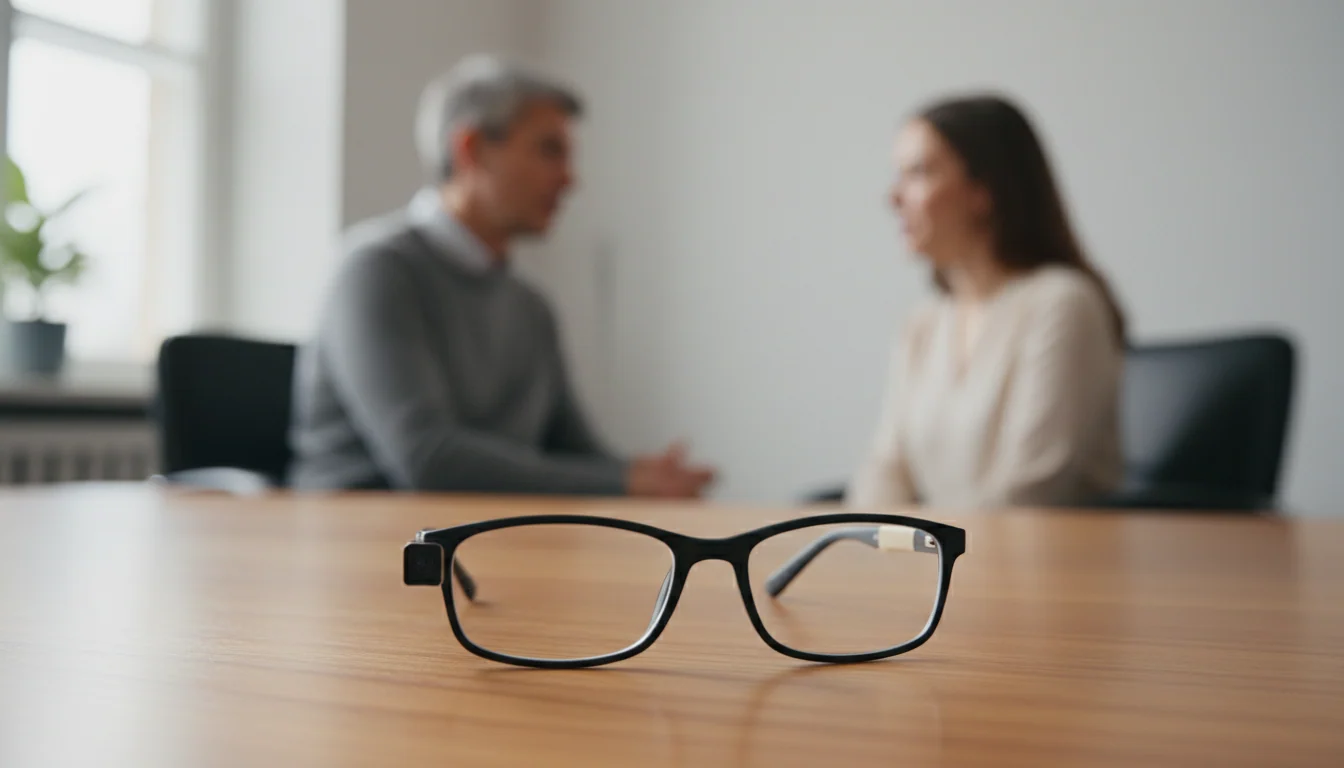
On 19 November 2026 the Dutch Data Protection Authority advised consumers against buying AI camera glasses for general use after testing six models. Decision-makers would be wise to postpone broad admission in sensitive settings until recording, data processing and security are demonstrably transparent, hard to circumvent and suitably bounded.
The advice does not only concern the private buyer. For organisations considering deploying such glasses or allowing them on their premises, the question shifts from is this allowed to under which demonstrable conditions is this allowed. That shift deserves its own consideration, especially because recent research shows that the most visible safeguard, the recording light, means less in practice than is often assumed.
What exactly has the Dutch Data Protection Authority established about AI camera glasses?
The Dutch Data Protection Authority examined six AI camera glasses and reported serious risks for both wearers and bystanders. On that basis the supervisory authority advises against the purchase for general use. These are devices with cameras, microphones and analysis functions that can capture and process their surroundings.
The Dutch Data Protection Authority points to serious risks for users and bystanders. The discreet appearance of such glasses can facilitate hidden recording. Those who are captured often do not notice it. For context, we earlier discussed the DPA test of six AI camera glasses with a flawed emergency claim.
Why, according to research, is a visible recording light no watertight safeguard?
A recording light seems the obvious solution, but the protection it offers is limited. A peer-reviewed 2026 conference study combined a survey, a field experiment and an occlusion test. The outcome: bystanders often did notice the wearer, but did not reliably recognise that the device had a camera or that recording was taking place.
In the tested attack the indicator was successfully circumvented in all cases by covering it before recording. According to this research into LED signalling on AI glasses, the study supports the narrower conclusion that a light on its own does not constitute a reliable privacy notice or security measure. The EDPB similarly states in its statement on smart glasses that transparency measures must be effective and hard to circumvent, and that current indicators insufficiently inform many non-users.
In our assessment this changes the burden of proof. In our analysis, as long as a wearer or administrator cannot demonstrate that the signalling is not easily physically disabled, a visible light may not count as a watertight safeguard. That is not a legal judgement, but a practical consequence of the published evidence.
What does this mean for directors, lawyers and CISOs who have to assess admission?
Our analysis: because the Dutch Data Protection Authority advises against purchase for general use and research shows that bystanders do not reliably recognise recording, admission without demonstrable conditions creates significant privacy and governance concerns wherever employees, patients, clients or visitors may be recorded. Our policy recommendation is that the responsible officer establish an explicit admission policy and, as a precaution, prohibit AI camera glasses in consulting rooms, treatment rooms, teaching rooms and confidential meeting rooms. Because the European Data Protection Board states that manufacturers and providers of connected AI services cannot shift their own data-protection responsibilities to the user, a supplier label or user manual does not suffice as evidence; our recommendation is that the organisation, with appropriate legal and privacy input, separately verify and document the processing purposes, legal basis, retention periods, transfers outside the EU and security measures in the appropriate records, such as a processor agreement and, where required or appropriate, a DPIA. Because the recording indicator was physically circumvented in the occlusion test, the study supports our assessment that signalling alone should not be treated as a sufficient control measure. In our assessment, the deployment should be technically bounded, for instance by excluding recording or analysis functions where they are unnecessary and by linking use to an authorised, auditable workflow. Because the Luxembourg supervisory authority CNPD addresses the obligations and risks relevant to professional users, an employer should, according to our analysis, itself record and check which deployment is permitted on its premises. Our recommendation is that the director record the decision to admit or refuse, with its date, reasoning and human approval, so that the organisation can later demonstrate that the matter was considered deliberately.
This line is consistent with our earlier discussion of AI third-party risk management for leaders and with our analysis that outsourcing does not shift responsibility and in itself does not mean that an organisation can ignore its own responsibilities.
Which safeguards should an organisation require before it allows AI camera glasses?
Our policy recommendation is to allow AI camera glasses broadly only when the supplier demonstrably makes clear when recording or AI analysis is active and how that signalling is comprehensible to bystanders and hard to circumvent. The European Data Protection Board acknowledges that personal, professional and assistive applications exist, but calls for a context-bound assessment. A blanket ban is therefore not necessary; a conditional admission with hard requirements is.
Before an admission decision, test at least the following points:
- Does the device demonstrate, comprehensibly and hard to circumvent, when it is recording or analysing, even if someone tries to cover the indicator?
- Which data is processed locally and which goes to external AI services, and does a legal basis and a processor agreement exist for it?
- Which retention periods and transfers outside the EU apply, and can the organisation check them?
- How are access and security arranged, and who can view images or audio?
- In which rooms is use excluded, and is that prohibition recorded and enforceable?
- Is the admission decision documented with reasoning and human approval?
Those who cannot demonstrably fill in these points would do better to postpone the acquisition or broad admission. That approach is consistent with the AP’s advice and with the CNPD’s guidance on responsible, context-bound use and the obligations of professional users. For more depth on the processing of personal data we refer to our topic hub on AI privacy and GDPR.
Sources and references
- AP raadt aankoop AI-camerabrillen af: ernstige risico's voor gebruikers en omstanders
- Statement 01/2026 on Smart Glasses
- EDPB publishes statement on the data protection challenges of smart glasses
- Visibility Does Not Equal Effective Privacy Notice: Rethinking LED Notice on AI Glasses
- Getting a clearer picture of smart glasses: the CNPD publishes new guidance
Sources: The article draws on the advice of the Dutch Data Protection Authority, the European Data Protection Board's smart glasses statement, guidance from the Luxembourg CNPD and peer-reviewed research via Springer Nature (ICICS 2026).